Flora Zones
Plant communities from high-elevation forests to desert shrublands: ecology and species across elevational gradients.
1 min readCh05 — Flora Zones
(Draft outline for expansion)
5.1 Floristic Provinces & Elevation Gradient Emery County straddles the ecological hinge between the Great Basin and Colorado Plateau, and its plant communities march upslope in distinct, climate-driven bands. Below ≈4,500 ft, saline valley floors and benches support salt-desert shrubs—shadscale, four-wing saltbush, and greasewood—adapted to high soil salinity and minimal precipitation. Between ≈4,500 and 6,000 ft, the sagebrush steppe emerges, dominated by basin big sagebrush and Indian ricegrass, providing winter forage for mule deer and pronghorn. The pinyon-juniper belt (≈5,500–7,000 ft) cloaks rocky uplands, where single-leaf piñon and Utah juniper form woodlands with Gambel oak understory. From ≈7,000 to 9,000 ft, mixed-conifer forests of ponderosa pine, Douglas-fir, and white fir transition to subalpine Engelmann spruce and subalpine fir groves above ≈9,500 ft. Alpine meadows atop the Wasatch Plateau host cushion plants and late-summer wildflowers. These floristic zones reflect temperature lapse rates (~3 °F per 1,000 ft), precipitation gradients, and soil chemistry—making Emery County a living transect of Intermountain West botany.
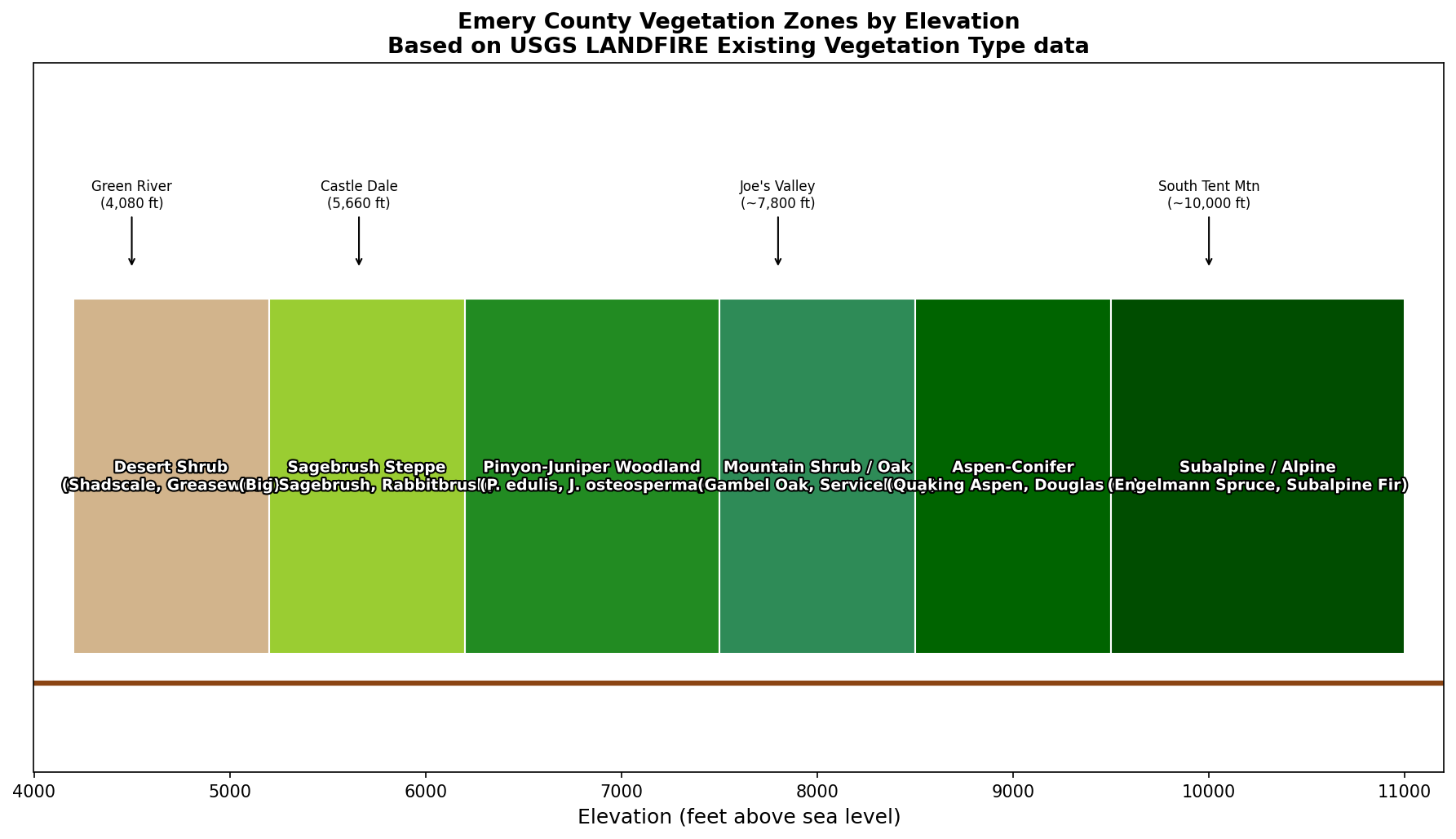
Suggested for 5.1:
- Sources: Welsh, Stanley L., N. Duane Atwood, Sherel Goodrich, and Larry C. Higgins. A Utah Flora. 4th ed. Provo, UT: Brigham Young University, 2003.
- Map: Elevation band plant community map with floristic province boundaries.
- Figure: Composite elevation gradient profile annotated with key indicator species.
- Photograph: Transition zone photograph showing sagebrush bench to pinyon-juniper woodland.
- Table: Summary of plant zone elevational ranges, dominant species, and mean annual precipitation.
5.2 Salt‑Desert Shrublands Salt‑desert shrublands occupy the lowest benches and basin floors of Emery County, typically below 4,500 feet elevation, where soil salinity and seasonal drought stress select for highly salt‐tolerant (halophytic) vegetation. Dominant species include Atriplex confertifolia (shadscale), Sarcobatus vermiculatus (greasewood), Atriplex canescens (fourwing saltbush), and Pleuraphis jamesii (sand dropseed), forming open, low‐growing mosaics on calcic and gypsic soils. Soil salinities range from 2 to over 10 dS/m, reflected in broad leaf succulence and specialized salt‐excretion bladder cells. Cryptobiotic soil crusts—composed of cyanobacteria, lichens, and mosses—stabilize surface sediments, reduce erosion, and enhance nitrogen fixation, though they are vulnerable to trampling by off‐road vehicles. Seasonal moisture from infrequent storms triggers ephemeral wildflower displays of Desert Primrose (Oenothera deltoides) and Blazing Star (Mentzelia decapetala). Wildlife use includes essential winter forage for pronghorn (Antilocapra americana) and mule deer (Odocoileus hemionus), as well as critical habitat for Botteri’s sparrow (Peucaea botterii) and horned lizard (Phrynosoma platyrhinos). Management challenges involve balancing grazing pressure, mitigating invasive Tamarix ramosissima, and restoring crust integrity after disturbance. Recent BLM restoration trials use native seed mixes and microbiotic‐crust inocula to accelerate recovery on degraded flats. Understanding the abiotic controls of soil salinity and geomorphic substrate informs successful conservation and sustainable use of these unique shrubland ecosystems.
Suggested for 5.2:
- Sources: USDA NRCS (2007) Soil Survey of Emery County Area, Utah; Zenn & Anderson (2012) “Ecology of Salt‑Desert Shrub Communities.”
- Map: Distribution of salt‑desert shrublands over soil salinity isocontours.
- Figure: Vegetation transect diagram showing species zonation across salinity gradient.
- Photograph: Shadscale flats near Muddy Creek with cryptobiotic crust.
- Table: Key shrub species: scientific name, common name, salinity tolerance (dS/m), growth form, wildlife value.
5.3 Sagebrush Steppe Transition Between approximately 4,500 and 6,000 feet, Emery County’s sagebrush steppe transition forms a mosaic between lower-elevation salt deserts and upland pinyon–juniper woodlands. Dominated by Artemisia tridentata subspecies (basin big sagebrush and Wyoming big sagebrush), this zone features an understory of perennial bunchgrasses such as Indian ricegrass (Achnatherum hymenoides), needle-and-thread grass (Hesperostipa comata), and Sandberg bluegrass (Poa secunda). Annual precipitation ranges from 8 to 12 inches, with cold winters and warm, dry summers influencing phenology. Soils are typically well-drained loams to sandy loams, formed on alluvial fans and colluvial slopes, with a thin organic horizon. Fire historically maintained open stands at 60–100-year intervals, but invasive cheatgrass (Bromus tectorum) has reduced fire return intervals to 10–20 years in some areas, altering species composition and habitat quality. Wildlife—including pronghorn, mule deer, and sage grouse—depend on sagebrush for forage, cover, and breeding grounds. Cultural uses by Numic-speaking peoples include medicinal and ceremonial gathering of sagebrush and associated forbs. Management challenges center on balancing grazing, invasive-species control, and prescribed burning to sustain plant diversity and ecosystem services.
Suggested for 5.3:
- Sources: Murdock, A.P., & Shrestha, R.P. (2015) Sagebrush Ecology in the Intermountain West; USDA NRCS (2007) Soil Survey of Emery County Area, Utah.
- Map: Sagebrush subspecies distribution overlaid with precipitation isohyets.
- Figure: Ecotone diagram showing species composition gradients from <4,500 to 6,000 ft.
- Photograph: Spring wildflower bloom beneath basin big sagebrush on San Rafael River benches.
- Table: Key flora metrics: species, elevation range, fire return interval, wildlife value.
5.4 Pinyon–Juniper Woodlands Pinyon–juniper woodlands dominate mid-elevations in Emery County, roughly between 5,500 and 7,500 feet, forming the largest vegetation belt by area. The overstory typically comprises Pinus edulis (two‑needle pinyon) and Juniperus osteosperma (Utah juniper), often mixed with scattered Juniperus scopulorum (Rocky Mountain juniper) on north‑facing slopes. Understory grasses and forbs include Indian ricegrass (Achnatherum hymenoides), needle-and-thread grass (Hesperostipa comata), and gooseberry maple (Acer glabrum) seedlings in mesic microsites. Pinyon nuts are a keystone resource for wildlife and people, with mast years every 2–5 years driven by climatic cues. Woodland structure varies with soil depth and aspect: shallow soils on slickrock yield open stands with stunted trees, while deeper colluvial soils support dense canopies reaching 20 ft tall. These woodlands play a critical role in soil stabilization, snow capture, and wildlife habitat (e.g., pinyon jays, mule deer). Recent climate warming and beetle outbreaks have stressed some stands, prompting management discussions on controlled thinning and restoration.
Suggested for 5.4:
- Sources: Baruch-Mordo et al. (2013) “Shrubland to Woodland Transitions in the Intermountain West”; Miller & Wigand (1994) “Holocene Pinyon–Juniper Woodlands Dynamics”.
- Map: Pinyon–juniper belt distribution by elevation and aspect.
- Figure: Pinyon seed mast cycle chart showing years of high and low nut production.
- Photograph: Close-up of two‑needle pinyon nut clusters and juniper berries on plateau ridge.
- Table: Woodland structural metrics: tree density, canopy cover, and average height by elevation band.
5.5 Mountain Brush Zone Mountain brush stands occur primarily between 7,000 and 9,000 feet, where moisture availability and cooler temperatures support fire-adapted shrub communities. Dominated by Gambel oak (Quercus gambelii), serviceberry (Amelanchier utahensis), and mountain mahogany (Cercocarpus ledifolius), these thickets occupy canyon rims, midslope benches, and sheltered draws. Gambel oak forms dense, multi-stemmed clonal thickets that resprout vigorously after fire, while serviceberry provides early-season fruit and nectar resources. Mountain mahogany thrives on well-drained gravels and talus slopes, anchoring soils with deep roots and offering critical winter browse for mule deer. Understory grasses—such as Poa fendleriana (muttongrass) and Festuca idahoensis (Idaho fescue)—and forbs like Penstemon clutei (Clute’s penstemon) add structural diversity and seasonal color. Fire regimes historically cycled every 20–40 years, maintaining a mosaic of age classes; however, fire suppression and pinyon–juniper encroachment have altered brush density and composition. Ethnobotanical uses by Ute and Paiute include oak acorn grinding and mahogany stem weaving. Conservation efforts focus on restoring natural fire regimes and controlling conifer encroachment to preserve shrubland biodiversity.
Suggested for 5.5:
- Sources: Bartos, D. L., and W. F. Mueggler. Gambel Oak in Utah and Colorado — Its Response to Management. USDA Forest Service Research Paper INT-252. Intermountain Forest and Range Experiment Station, 1981; Shepperd, W. D. (2001) “Oak Ecology and Management in the Arid West,” Journal of Range Management.
- Map: Distribution of mountain brush zone by elevation and aspect.
- Figure: Species composition pie chart showing relative cover of Gambel oak, serviceberry, and mahogany.
- Photograph: Springtime Gambel oak thicket on North Horn Mountain rim.
- Table: Indicator species list: dominant shrub, elevation range, fire-resilience trait, ethnobotanical use.
5.6 Ponderosa Pine & Mixed Montane Forests Emery County’s mid-to-upper montane woodlands, spanning roughly 7,500 to 9,000 ft, are dominated by Pinus ponderosa var. scopulorum (Rocky Mountain ponderosa pine), Pseudotsuga menziesii (Douglas-fir), and stands of Abies concolor (white fir) in cooler, north-facing coves and canyon bottoms where late-season snow persists. These forests develop on deep, well-drained loamy soils derived from Navajo Sandstone and Mancos Shale, supporting a diverse understory of Mahonia repens (creeping barberry), Amelanchier alnifolia (serviceberry), Carex geyeri (elk sedge), and Lupinus argenteus (silvery lupine). Typical fire-return intervals ranged from 50 to 100 years, creating open-park-like stands; however, fire suppression and bark beetle outbreaks in recent decades have led to increased fuel loads and susceptibility to high-severity fires. Ponderosa pine bark’s fire-resistant qualities and deep root systems confer resilience to drought and low-intensity burns, making them a keystone species for forest management plans. These woodlands also support wildlife such as Clark’s nutcracker, black bear, and mule deer, and provide culturally significant pine nuts historically harvested by Numic peoples. Effective restoration approaches combine controlled burns, mechanical thinning, and mule deer forage enhancement to maintain forest health and reduce catastrophic fire risk.
Suggested for 5.6:
- Sources: Baruch-Mordo et al. (2013) “Shrubland to Woodland Transitions in the Intermountain West”; Miller & Wigand (1994) “Holocene Pinyon–Juniper Woodlands Dynamics”.
- Map: Montane forest distribution overlain on elevation contours and aspect.
- Figure: Seasonal phenology chart of understory flowering and pine-nut production cycles.
- Photograph: Close-up of two-needle pinyon nut clusters and juniper cones on sandstone outcrop.
- Table: Forest structural summary: tree density, canopy cover, basal area, and mean height by elevation band.
5.7 Subalpine Spruce–Fir & Alpine Meadows Above approximately 9,000 feet on Emery County’s high ridges and plateaus, the subalpine zone transitions from dense Engelmann spruce–subalpine fir forests to windswept alpine meadows. Picea engelmannii (Engelmann spruce) and Abies lasiocarpa (subalpine fir) dominate sheltered north-facing slopes and canyon floors, supporting understories of Vaccinium globulare, Menziesia ferruginea, and a rich lichen carpet. As elevation and exposure increase, trees assume krummholz forms—stunted, wind‐pruned growth that merges into discontinuous stands.
Above tree line (~10,500 ft), alpine meadows emerge as mosaics of cushion plants (e.g., Oreoxis alpina), sedges (Carex hoodii), and spring-blooming forbs like Penstemon degeneri, Aquilegia caerulea, and tufted hairgrass. Seasonal snowpack persists into July in snowdrift hollows, shaping soil moisture and extending flowering windows. These meadows host microfauna (Collembola, Chironomidae pupae) in snowmelt ponds and support migrating species such as Clark’s nutcracker.
Recent climate trends show a decline in peak snow-water equivalent (–8 % per decade at Scofield Crest) and earlier melt-out dates, leading to phenological advances of 4–6 days in bloom onset. Warmer summer temperatures have facilitated spruce beetle outbreaks, observed at 9,200 ft in 2018, stressing fir populations. Fire scars are rare but notable, with post-fire succession creating nutrient-rich forb meadows adjacent to burned old-growth stands. Conservation strategies emphasize limiting foot traffic via designated trails, monitoring snowpack and insect impacts, and mapping krummholz boundary shifts.
Suggested for 5.7:
- Sources: Stevens, R., & Stevens, M.A. (1998). Alpine Vegetation of the Colorado Plateau. Grand Canyon Trust Field Reports.; U.S. Forest Service (2015). Subalpine Forest Vitality and Insect Disturbance Assessment. Intermountain Region.; Martin, P., & Eide, W. (2017). “Spruce Beetle Outbreaks at High Elevations.” Forest Ecology and Management 399: 123–134.
- Map: Elevation‐band map delineating subalpine forest vs. alpine meadow zones.
- Figure: Growth‐form schematic of krummholz vs. upright trees and meadow interface.
- Photograph: Summer wildflower carpet in alpine meadow near Little Park SNOTEL site (9,850 ft).
- Table: Key subalpine and alpine species list with elevation range, soil moisture niche, and bloom phenology.
5.8 Riparian Corridors & Wetlands Emery County’s riparian corridors thread lush vegetation through its predominantly arid landscapes, clustering along perennial streams—most notably the Green, San Rafael, and Price rivers—and at spring-fed seeps. Dominant canopy species include Fremont cottonwood (Populus fremontii), narrowleaf willow (Salix exigua), and occasional box elder (Acer negundo), forming gallery forests that stabilize banks and moderate water temperatures. Understory layers of sedges (Carex spp.), rushes (Juncus spp.), and native grasses thrive in seasonally saturated soils, while downstream reaches host emergent marshes dominated by cattails (Typha latifolia) and bulrushes (Schoenoplectus spp.). Beavers (Castor canadensis) play a keystone role: their dams raise water tables, expand wetland mosaics, and enhance habitat complexity for amphibians and riparian bird species. Hyporheic exchange zones—where surface water infiltrates channel gravels—sustain baseflows and maintain water quality during dry spells.
Riparian zones also provide critical wildlife corridors and recharge areas, buffering flood peaks and filtering sediment. However, invasive tamarisk (Tamarix ramosissima) and Russian olive (Elaeagnus angustifolia) threaten these native communities by altering hydrology and competitive dynamics. Restoration initiatives by BLM and local watershed councils focus on invasive removal, native replanting, and beaver-assisted water retention.
Suggested for 5.8:
- Sources: Stevens, L.E., and V.J. Meretsky. 2008. Riparian Ecology in the American Southwest; U.S. Fish & Wildlife Service. 2017. Riparian Wetland Assessment Report; Bureau of Land Management. 2020. Emery County Springs & Riparian Inventory.
- Map: Riparian vegetation distribution overlay on 2020 aerial imagery with streamflow gauge locations.
- Figure: Schematic cross-section of a healthy riparian corridor showing canopy, understory, and hyporheic zones.
- Photograph: Fremont cottonwood gallery along the San Rafael River near Goblin Valley Road.
- Table: Riparian plant species checklist with habitat codes, elevation range, and abundance ratings.
5.9 Rare, Endemic & Relict Species Emery County harbors a remarkable assemblage of rare, endemic, and relict plant species that testify to its unique geology and microclimates. The San Rafael cactus (Pediocactus despainii), confined to calcic outcrops within the San Rafael Swell, produces vibrant magenta blooms in spring. Wright’s fishhook cactus (Sclerocactus wrightiae) thrives on sandy terraces along the Green River, its hooked spines nearly camouflaged against the substrate. The Cisco milkvetch (Astragalus despainii) is restricted to Mancos Shale benches near Cisco, adapted to thin, seasonally saturated soils. Alpine relicts such as Polemonium pulcherrimum persist in snow-drift hollows above 10,000 ft—Pleistocene survivors in cool refugia. Additional special-status taxa include Frankenia jamesii and Astragalus coccineus, each tied to saline or gypsum-rich seeps. Population counts often number fewer than 500 plants, and specialized habitat needs make these species vulnerable to grazing, road dust, and climate shifts. Conservation measures by the Utah Natural Heritage Program and BLM include population monitoring, seed banking, and invasive tamarisk removal to protect spring habitats. Studying these rare taxa underscores Emery County’s role as a botanical hotspot and informs regional biodiversity strategies.
Suggested for 5.9:
- Sources: Utah Natural Heritage Program (2022) Rare Plant List; U.S. Fish & Wildlife Service (2010) Recovery Plan for Pediocactus despainii; Welter, J.R. (2018) Flora of the San Rafael Swell.
- Map: Known occurrences map of rare and endemic species overlaid on soil and substrate types.
- Figure: Montage of flowering cacti and alpine relicts in their native habitats.
- Photograph: Close-up of Pediocactus despainii in bloom on Cedar Mesa Sandstone.
- Table: Summary of rare species: scientific name, common name, conservation status, habitat type, elevation range.
5.10 Seasonal Wildflower Calendar Emery County’s high-desert through subalpine landscapes come alive each spring in an elevational wave of wildflower blooms driven by snowmelt and monsoon moisture. Phenological observations from 2010–2024 reveal:
- April–May (<5,000 ft): Desert ephemerals like desert paintbrush (Castilleja chromosa), sand violet (Viola pedatifida), and glory-of-the-snow (Chionophila jamesii) carpet lower valley benches.
- June (5,000–7,000 ft): Pinyon–juniper understories burst with Indian paintbrush (Castilleja angustifolia), silvery lupine (Lupinus argenteus), and desert marigold (Baileya multiradiata).
- July (7,000–9,000 ft): Montane meadows host blazing star (Mentzelia multiflora), Colorado columbine (Aquilegia caerulea), and butterfly milkweed (Asclepias tuberosa).
- August (>9,000 ft): Alpine zones peak with Degener’s penstemon (Penstemon degeneri), fringed gentian (Gentiana fremontii), and alpine phlox (Phlox austromontana).
Interannual variability—first bloom dates shifting 5–7 days earlier over three decades—reflects warming and altered snowpack regimes. This calendar underpins ecotourism scheduling, pollinator habitat mapping, and citizen-science phenology projects.
Suggested for 5.10:
- Sources: Utah Native Plant Society (2022) Utah Wildflower Calendar; iNaturalist (2010–2024) phenology dataset; Holycross & Evans (2019) “Montane Wildflower Phenology.”
- Map: Elevation-based isopleth map showing median bloom dates for key indicator species.
- Figure: Timeline chart of first, peak, and last bloom dates by elevation band.
- Photograph: Collage of wildflower arrays at low, mid, and high elevations along Temple Mountain Road.
- Table: Phenological summary table: species, bloom onset, peak month, elevation range.
5.11 Fire Ecology & Post‑Disturbance Succession Fire is a fundamental ecological process shaping Emery County’s plant communities, with historical regimes varying by zone. In sagebrush steppe (4,500–6,000 ft), low-intensity surface fires historically occurred every 50–100 years, maintaining open Artemisia stands and nutrient cycling. Pinyon–juniper woodlands experienced mixed-severity burns at ~100–200 year intervals, creating a mosaic of age classes in overstory pines and junipers. In mountain brush (7,000–9,000 ft), periodic crown fires (intervals of 60–120 years) cleared Gambel oak thickets, facilitating recruitment from seedbanks. Post-disturbance succession begins with opportunistic forbs and grasses—particularly Indian ricegrass (Achnatherum hymenoides) and lupines (Lupinus spp.)—which stabilize soils and fix nitrogen. Shrub resprouters like Gambel oak and serviceberry regenerate vegetatively, while seeders such as mountain mahogany emerge on exposed mineral soil. Subalpine forests recover slowly over centuries, with Engelmann spruce and subalpine fir seedlings establishing in nurse logs and sheltered microsites. Fire exclusion since the early 20th century has increased fuel loads, leading to more severe, stand-replacing events and challenging natural resilience. Management approaches now emphasize prescribed burns, mechanical thinning, and seeding of native bunchgrasses to restore historical fire regimes and support biodiversity. Understanding fire return intervals, fuel dynamics, and adaptive traits of local flora is critical for mitigating wildfire risk and promoting ecosystem recovery under changing climate conditions.
Suggested for 5.11:
- Sources: Keeley, J.E. & Zedler, P.H. (2009). “Large, High‐Severity Fire Events in Southern California Shrublands.” Ecosphere 1(1):1–16.; Miller, R.F. et al. (2013). “Fire Regimes, Vegetation Change, and Self‐Organization.” General Technical Report RMRS‐GTR‐310, USDA Forest Service.; Stevens, J.T. & Glenn, N.F. (2018). “Post‐Fire Succession in Artemisia Steppe.” Plant Ecology 219:1023–1039.
- Map: Historic fire frequency and severity map overlaid on vegetation zones.
- Figure: Successional timeline diagram from immediate post-fire colonizers to mature community.
- Photograph: Recent prescribed burn in sagebrush steppe showing fire effects and early regeneration.
- Table: Fire regime summary by vegetation zone: return interval, severity, key functional groups.
5.12 Invasive Species & Land‑Management Responses Invasive plant species such as Bromus tectorum (cheatgrass), Tamarix ramosissima (saltcedar), and Carduus nutans (musk thistle) have transformed disturbed and riparian habitats across Emery County. Cheatgrass dominates post‑disturbance sagebrush steppe and pinyon–juniper understories, creating fine fuel loads that promote more frequent fires and hinder shrub and grass recovery. Saltcedar colonizes spring seeps and streambanks, raising evapotranspiration rates and altering soil salinity, while musk thistle invades road cuts and overgrazed meadows, reducing forage quality. Management responses include targeted herbicide applications timed to pre‑seed germination windows, mechanical removal of saltcedar followed by native willow and cottonwood replanting, and strategic grazing rotations to suppress cheatgrass while promoting perennial grasses. Restoration success is measured through long‑term monitoring of species cover, fuel loads, and fire return intervals, as documented in recent BLM and NRCS trial plots. Understanding life‑history traits of invasives, combined with adaptive management frameworks, is essential for sustaining native communities and reducing wildfire risk under changing climate conditions.
Suggested for 5.12:
- Sources: Novak, S.J. et al. (2011) “Ecology and Management of Cheatgrass.” Rangeland Ecology & Management 64: 543–553; Di Tomaso, J.M. (1998) “Impact, Biology, and Ecology of Saltcedar.” Weed Technology 12: 326–336; Krueger, S. (2020) “Invasive Plant Restoration in Eastern Utah.” BLM Technical Note 437; Roundy, B.A. et al. (2016) “Cost‑Effective Chemical Control of Musk Thistle.” Journal of Invasive Plant Science 6: 217–230.
- Map: Distribution of invasive species hotspots by habitat type across Emery County.
- Figure: Lifecycle diagram of cheatgrass and fuelbed development relative to native perennial grasses.
- Photograph: Infestation front of saltcedar along the Fremont River near Hanksville.
- Table: Management treatments matrix: species, control method, timing, efficacy rate.
(End of Chapter 5 Draft)