Part 5 · Field Guide
Travel & Logistics
The practical infrastructure of visiting Emery County: I-70's longest service-station gap in the lower 48 (the 'fill up every time' rule), the gateway communities of Green River (pop. 902), Price, Castle Dale, Ferron, and Hanksville, lodging and camping by community and BLM dispersed area, fuel and food and water planning, the spotty cellular coverage that makes a satellite communicator close to mandatory, visitor centers and ranger stations, BLM and state-park permits and fees, the four-season climate split between the Wasatch Plateau and the Swell, EMSAR contact protocols, the Ten Essentials adapted for desert canyon country, and a sustainable-visitation framework.
Ch36 — Travel & Logistics
36.1 The Longest Gap on I-70
Between the Green River exit on Interstate 70 and the next services at Salina, in Sevier County, the road runs for one hundred and ten miles without a gas station, a diner, or a motel. It is the longest stretch of the United States Interstate Highway System without commercial services, and it cuts across the heart of Emery County. The crossing — climbing through Spotted Wolf Canyon, threading the cliffs of the San Rafael Reef, descending through the slickrock of the Swell’s southern flank — is, for many visitors, the first hint that Emery County does not run on the rhythms of a typical road trip. Here, planning is the precondition for everything else: the canyon hike, the dark sky, the dinosaur quarry. A full fuel tank and a packed cooler are not extras. They are the price of admission.
This chapter is a practical companion to the activity chapters of Part V. Chapters 30 through 35 describe what there is to do in Emery County (see Ch30: Landscapes of Adventure ↗ 5 Ch30: Landscapes of Adventure A practical field guide to Emery County's adventure landscape: San Rafael Swell slot canyons and OHV routes, Goblin Vall... Read chapter → ); this chapter describes how to actually get there, where to stay, where to ask for help, and how to leave the country in better shape than you found it. The county’s recreational riches — the San Rafael Swell, Goblin Valley State Park, the Wasatch Plateau high country, the Green River corridor — sit largely outside the day-to-day reach of services. Even Castle Dale, the county seat, has only one or two fuel stations and a single grocery store. Once you turn off the paved highway, you are responsible for yourself. The reward is solitude on a scale the more famous Utah destinations cannot match. The price is a kind of careful self-sufficiency.
The stretch of Interstate 70 between Green River and Salina runs 110 miles with no gas station, no diner, and no motel — the longest gap in commercial services anywhere on the U.S. Interstate Highway System, and it crosses the heart of Emery County. When it was completed in 1990, it was among the very last pieces of the original Interstate System to be finished. Next time you fill up in Green River, look at your gauge and ask: could you make it 110 miles from here — plus a side trip into the Swell — on what's in the tank?
36.2 Highway Access and Driving Routes
Emery County is bisected east–west by Interstate 70 and stitched north–south by State Route 10. The county is reachable from every direction on paved highway, but the spacing of services and the seasonality of secondary roads reward a little homework.
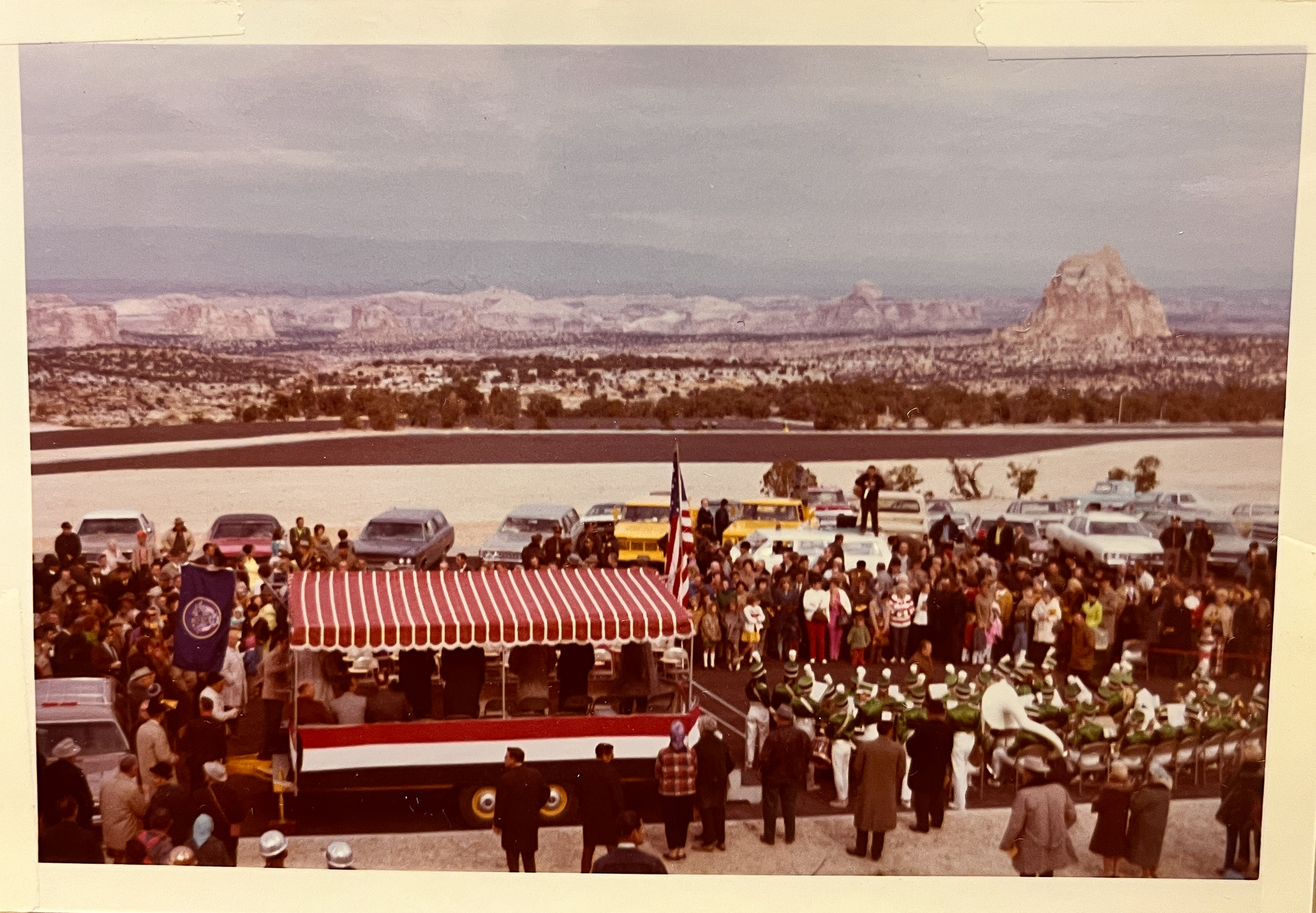
Interstate 70 enters the county from the east at Exit 158 (Green River business loop) and exits to the west near Exit 129 (the I-70/US-6 junction with Carbon County). Within the county, the interstate climbs through Spotted Wolf Canyon — engineered in the late 1960s, opened in stages between 1970 and 1990, and completed in 1990 as one of the final sections of the original Interstate Highway System (Glenwood Canyon in Colorado followed in 1992) (see Ch18: Rails, Roads & Infrastructure ↗ 3 Ch18: Rails, Roads & Infrastructure The transportation and utility networks that wove Emery County into the broader region: the Old Spanish Trail, the 1883 ... Read chapter → ) — and rises onto the western plateau by way of the San Rafael Reef cut. The exits between Green River and the western county line are gateways rather than service stops. Exit 131 takes drivers into Green River proper; Exit 147 leads north up Black Dragon Wash toward Buckhorn Draw; Exit 149 (Sinkhole / Behind the Reef) gives 4×4 access into the Swell interior; Exit 160 (SR-24) leaves the interstate toward Hanksville and Capitol Reef; Exit 164 reaches Temple Mountain Road and the southern Swell; Exit 175 (Ranch Exit) opens onto Justensen Flats and the Reds Canyon loop. Drivers should not rely on any of these exits for fuel, water, or cellular signal.
US-6 approaches the county from the north through Carbon County and joins I-70 at Exit 129. It is the principal artery from the Wasatch Front and is patrolled, plowed in winter, and within reliable cellular range for most of its length. State Route 10 branches south from US-6 and runs the length of populated Emery County, from Huntington at the north through Cleveland, Castle Dale, Orangeville, Ferron, and Emery, before joining I-70 west of Green River. SR-10 is the everyday road for residents and the principal point of access to every gateway community in the county.
State Route 29 climbs west from Orangeville and Castle Dale up Cottonwood Canyon to Joe’s Valley Reservoir, providing the most direct route to the Joe’s Valley bouldering area and the eastern slopes of the Wasatch Plateau. It is paved throughout but narrows above the reservoir and is subject to seasonal closure beyond the developed campground. State Route 31 ascends from Huntington west through Huntington Canyon, climbing past the Huntington Power Plant, the Forks of Huntington Campground, and into the Manti-La Sal high country before continuing to Fairview in Sanpete County. The section of SR-31 west of Electric Lake typically closes from late November through May, and travelers should check current conditions through UDOT before relying on it as a through route. State Route 155 is a short paved connector linking Cleveland and Elmo east of SR-10. State Route 24 crosses the southwestern corner of the county between Hanksville and I-70, serving as the principal route to Goblin Valley State Park.
Backcountry roads radiate from these paved arteries into the Swell and Wasatch Plateau. Buckhorn Wash Road — designated a National Backcountry Byway — runs north–south through the heart of the Swell from the Wedge area to the San Rafael Bridge campground and connects via the Cottonwood Wash road to SR-10 at Castle Dale. Wedge Road branches from Buckhorn Wash Road to the rim of the “Little Grand Canyon” of the San Rafael. Reds Canyon Loop, Tomsich Butte Road, Temple Mountain Road, and the Eccles Canyon route are unpaved BLM and county routes ranging from washboard gravel to high-clearance four-wheel-drive technical track. Up high, Skyline Drive traces the spine of the Wasatch Plateau between SR-31 and Sanpete County, opening to vehicle traffic in early summer once the snow has melted off the divide.
Conditions on the backcountry network change with the weather. The clay-rich tracks of the Swell become impassable when wet; washouts after monsoon storms can close routes for days. UDOT’s traffic map and the 511 information line give current conditions on paved roads; for unpaved routes, the BLM Price Field Office and the Emery County Sheriff’s Office are the authoritative contacts.
36.3 Gateway Communities and Base Camps
Visitors to Emery County typically arrive through one of four gateways, each oriented toward a different kind of trip.
Table 36-A — Gateways and Base Camps
| Community | Population (2020 Census) | Fuel | Best base for |
|---|---|---|---|
| Green River | 902 | Multiple stations | River floats, eastern Swell, chain lodging |
| Price (Carbon Co.) | 8,317 | Full inventory | Northern approach, hospital, supply runs |
| Castle Dale (county seat) | 1,492 | 1–2 stations | The Wedge, Buckhorn Wash, Cleveland-Lloyd |
| Hanksville (Wayne Co.) | 219 | Limited | Southern approach, Goblin Valley |
| Huntington | 2,131 | 2 stations | SR-31, northern Wasatch Plateau |
| Ferron | 1,648 | 1 station | Millsite SP, Ferron Canyon |
| Orangeville | 1,470 | — | SR-29, Joe’s Valley |
| Emery | ~285 | Intermittent | Southern SR-10 corridor |
Populations: U.S. Census Bureau, 2020 Decennial Census (exact counts per Ch36 fact-check). Fuel and base-camp characterizations: §36.3, §36.6.
Green River (population 902, U.S. Census 2020) sits at the eastern edge of the county on Interstate 70 and the river that gives it its name. It is the largest in-county lodging market and the principal staging point for river floats, for the eastern Swell, and for visitors continuing west to Capitol Reef and Bryce Canyon. The town hosts several national-chain hotels, the John Wesley Powell River History Museum, and the launching outfitters for Labyrinth Canyon and Desolation Canyon. Green River State Park, on the riverbank within the town, offers the most convenient developed campground in the eastern county. For travelers heading west on Interstate 70, Green River is the last reliable fuel and grocery stop before Salina, one hundred and ten miles distant.
Price is not in Emery County — it lies just across the line in Carbon County — but it serves as the practical northern gateway for almost everyone approaching from the Wasatch Front. With a population of approximately 8,300, Price has the only meaningful hospital in the region (Castleview Hospital), a full inventory of chain and independent hotels, a USU Eastern campus, the USU Eastern Prehistoric Museum, the BLM Price Field Office (which administers Emery County’s federal lands), and the Castle Country Travel Office. Travelers headed for the Wedge, Buckhorn Wash, Cleveland-Lloyd, or the SR-10 communities will typically stage from Price unless they have booked lodging further south.
Castle Dale is the county seat (population approximately 1,500) and the administrative center of Emery County. Although small, it is the single most important visitor stop in the western county because it houses the Emery County Travel Bureau, the BLM Emery County Visitor Center, and the Emery County Pioneer Museum — all co-located at 75 East Main Street. The town has a grocery store, fuel, a single full-service motel, and the county’s emergency-dispatch facility. For trips into the Wedge, Buckhorn Wash, or Cleveland-Lloyd, Castle Dale is the most convenient base camp.
Hanksville (Wayne County, population approximately 200) is the southern gateway. Tiny but strategically positioned at the junction of SR-24, SR-95, and SR-276, it offers the last fuel before Capitol Reef and Lake Powell and serves visitors approaching Goblin Valley State Park or the Henry Mountains from the south.
Within the county, secondary base camps deserve mention. Huntington (population approximately 2,100) sits at the mouth of Huntington Canyon and is the natural gateway to SR-31 and the northern Wasatch Plateau. Ferron (population approximately 1,600) is the “last fuel and grub” stop heading west into Ferron Canyon toward Millsite State Park and Ferron Reservoir. Orangeville (population approximately 1,400) is the jumping-off point for SR-29 and Joe’s Valley. Emery (population approximately 280) is the smallest of the SR-10 communities and the southernmost in-county stop before the SR-10/I-70 junction. None of these towns offers chain lodging, but each has at least one fuel station, a café or two, and the kind of small-town texture that travelers from elsewhere often remember long after the geological wonders blur together.
36.4 Lodging
The lodging market in Emery County is small, seasonal, and concentrated in Green River and the SR-10 corridor. Outside these communities, hotel beds vanish quickly.
In Green River, national chains include the Holiday Inn Express (one mile off I-70 with indoor pool, fitness center, and on-site laundry), the Comfort Inn, the Best Western River Terrace (adjacent to the Powell River History Museum), Motel 6, and Super 8. Independent properties include the Budget Inn, the River Terrace Inn, and the Robber’s Roost Motel. The town typically has enough capacity for non-peak periods but books fully during the Friendship Cruise (Memorial Day weekend), the river-rafting high season in May and June, and Capitol Reef-bound traffic in October.
In Castle Dale, the Village Inn Motel is the principal lodging option; supplementary capacity comes through short-term rentals on Airbnb, VRBO, and direct bookings via the Emery County Travel Bureau. In Huntington, a separate Village Inn Motel (independently owned, distinct from the Castle Dale property) offers a small block of rooms; seasonal vacation rentals supplement that capacity. Ferron and Emery offer thin and intermittent lodging — a B&B or short-term rental at any given time, but not always.
Short-term rentals have grown faster than the chain-hotel inventory in the past several years across the SR-10 communities, and the Emery County Travel Bureau maintains a current list at theswellutah.com. Visitors planning a trip during peak windows — spring break, Memorial Day, early October aspen, deer hunt opening weekends — should book at least a month in advance.
36.5 Camping
For the visitor willing to sleep outside, Emery County is one of the great camping landscapes in the West. The inventory spans developed state parks with hot showers, fee-managed BLM campgrounds with vault toilets and cottonwood shade, U.S. Forest Service campgrounds in the Wasatch Plateau aspens, and millions of acres of dispersed camping across the BLM and Forest Service estate.
Developed state-park campgrounds are the highest-comfort option. Green River State Park offers more than forty sites with hookups, river access, and reservations through the Utah State Parks system. Millsite State Park, near Ferron Reservoir, offers thirty-some sites in the cottonwood-lined valley below the reservoir dam, popular with anglers. Goblin Valley State Park’s campground sits beneath the hoodoo field; reservations are essential, and the park’s two yurts often book months ahead in spring and fall.
BLM campgrounds are the principal Swell-camping infrastructure. The San Rafael Bridge Campground, beside the historic San Rafael Swinging Bridge in Buckhorn Wash, offers around twenty primitive sites under a cottonwood gallery, with picnic tables, fire rings, vault toilets, and horse corrals at several sites. There is a per-night fee paid at the iron-ranger box, no potable water, and no hookups. The Wedge Overlook area offers small dispersed pullouts on the rim of the “Little Grand Canyon”; a vault toilet serves the immediate viewpoint, but bring water and expect first-come-first-served. Temple Mountain Campground, at the head of Temple Mountain Road, provides primitive sites convenient to Goblin Valley.
U.S. Forest Service campgrounds ring the Wasatch Plateau. Joe’s Valley Campground on the reservoir, Indian Creek Campground above Joe’s Valley, Forks of Huntington Campground in Huntington Canyon, and Old Folks Flat — along with other smaller sites — all close seasonally as soon as snow returns to the plateau (typically mid-October), reopening in late spring once the access roads dry out. Several USFS sites are reservable through recreation.gov; others remain first-come-first-served.
Dispersed camping is permitted on BLM lands across most of the Swell and on USFS lands across the Wasatch Plateau, subject to fire restrictions and area-specific closures. The general BLM rule is a fourteen-day stay limit and a requirement to move at least thirty miles between consecutive camps with the same individual. Several heavily-used zones have site-specific prohibitions on dispersed camping, including the area immediately around Goblin Valley State Park and within designated Wilderness Study Areas. A fire pan, a portable toilet, and a leave-no-trace ethic are the prerequisites to camping legally and responsibly in these zones.
Table 36-B — Campground Directory
| Campground | Agency | Sites | Water | Amenities | Fee / Reservations |
|---|---|---|---|---|---|
| Green River SP | Utah State Parks | 40+ | Yes | Hookups, showers, river access | Fee; reserveamerica.com |
| Millsite SP | Utah State Parks | ~30 | Yes | Below reservoir dam; angling | Fee; reserveamerica.com |
| Goblin Valley SP | Utah State Parks | Developed sites + 2 yurts | Yes | Beneath hoodoo field | Fee; reservations essential |
| San Rafael Bridge | BLM | ~20 primitive | No | Vault toilets, fire rings, horse corrals | Per-night, iron ranger |
| Wedge Overlook | BLM | Dispersed pullouts | No | Vault toilet at viewpoint | Free; first-come |
| Temple Mountain | BLM | Primitive | No | Convenient to Goblin Valley | — |
| Joe’s Valley | USFS | — | — | On reservoir; seasonal (≈mid-Oct close) | Fee; some recreation.gov |
| Indian Creek | USFS | — | — | Above Joe’s Valley; seasonal | Fee |
| Forks of Huntington | USFS | — | — | Huntington Canyon; seasonal | Fee |
| Old Folks Flat | USFS | — | — | Huntington Canyon; seasonal | Fee |
Camping infrastructure described in §36.5. Em-dashes mark values the chapter does not state — no counts estimated. Verify site counts and current fees against agency pages before print.
36.6 Fuel, Food, Water, and Supplies
The fuel rule in Emery County is simple: fill up at every opportunity. The I-70 service gap between Green River and Salina is the longest of any interstate segment in the United States. Outside the SR-10 communities and Green River, there is no fuel anywhere — no fuel in the Wedge, no fuel in Buckhorn Wash, no fuel at Cleveland-Lloyd, no fuel at Goblin Valley, no fuel on Skyline Drive, no fuel at Joe’s Valley once the day-use crowds have left. Reliable in-county pumps are in Green River (multiple), Castle Dale (one to two), Huntington (two), Ferron (one), and Emery (intermittent). Out-of-county pumps that matter to most trips are Price (full inventory), Salina (interstate corridor), and Hanksville (limited, but the last fuel before Capitol Reef).
Grocery and supplies. Green River, Castle Dale, Huntington, and Ferron each have a small full-service grocery store; the SR-10 towns also have one or two convenience stores. For big-box shopping — large coolers, specific cuts of meat, large water containers, fuel canisters, and so on — Price is the closest practical option, although a thorough run through a Wasatch Front Costco or REI on the way in is the strategy most experienced visitors adopt. Hardware needs (tarps, rope, gasoline cans, replacement tire valve stems) can usually be met at the small hardware stores in Castle Dale, Ferron, or Huntington, but selection is thin.
Water. The SR-10 communities all have municipal water on tap; campers can refill at hosted state-park campgrounds (Green River, Millsite, Goblin Valley). Most BLM and USFS primitive sites have no water at all. The rule of thumb is one gallon per person per day in shoulder seasons and at least two gallons per person per day in summer. Add to that water for cooking and dishes, water for the dog, and a contingency reserve. Five-gallon jerry cans are the standard tool; many Swell campers carry twenty-five to forty gallons in the truck on a multi-day trip.
Ice and cold storage. Ice is sold at every gas station in Green River and at most SR-10 fuel stops. In the high heat of July and August, plan to refresh the cooler every other day; a quality hard cooler holds ice three to five days, but cheap coolers measured in hours.
36.7 Cellular Coverage and Connectivity
Cellular coverage in Emery County is uneven and unreliable. The SR-10 corridor and the larger I-70 communities (Green River, the highway corridor near the major exits) have reliable LTE on Verizon and AT&T. Coverage on I-70 itself is spotty between exits; T-Mobile is the weakest of the major carriers across the county.
Inside the Swell — Buckhorn Wash, the Wedge, Mexican Mountain, Reds Canyon, Tomsich Butte, the Black Box, most of the Goblin Valley access roads — cellular coverage is functionally absent. Up on the Wasatch Plateau, the moment SR-31 climbs into Huntington Canyon, signal drops. Skyline Drive picks up occasional Verizon from the Wasatch Front side, but the signal is unreliable.
The implications for trip planning are straightforward. Download offline maps before leaving paved roads — Gaia GPS, onX Offroad, and CalTopo all support offline tiles. Carry a satellite communicator (Garmin inReach Mini, Zoleo, or, for iPhone 14 and later, the built-in Emergency SOS via satellite) for any backcountry trip. Do not rely on phone calls or text messages while inside the Swell or above 8,000 feet on the plateau. Tell someone where you are going and when you expect to be back; that single habit is the most important safety practice in Emery County.
Internet. All Emery County hotels and most short-term rentals provide Wi-Fi. The Emery County Library branches — in Castle Dale, Green River, Huntington, Ferron, and Emery — all offer free public Wi-Fi during open hours and are the most reliable in-town place to download maps, check weather, or pick up printed brochures. The Emery County Travel Bureau in Castle Dale also has Wi-Fi and physical inventory of BLM and state-park maps.
36.8 Visitor Centers and Information
Three visitor centers within Emery County and a fourth just across the county line in Price together cover most informational needs.
The Emery County Travel Bureau and the BLM Emery County Visitor Center, co-located at 75 East Main Street in Castle Dale, are the principal in-county information stop. The travel bureau ((435) 381-2600; (888) 564-3600; travel@emery.utah.gov; theswellutah.com) stocks BLM topographic maps, the Cleveland-Lloyd Quarry brochure, the Wedge and Buckhorn Wash interpretive guides, and a curated preferred-vendor list of regional outfitters. The shared space also houses the Emery County Pioneer Museum, a small but well-curated collection covering the county’s settlement and mining history. The center is open Monday through Saturday year-round with reduced winter hours.
The John Wesley Powell River History Museum, at 1765 East Main Street in Green River, serves the eastern county. It is the principal pre-trip stop for visitors floating the Green River, with extensive exhibits on Powell’s 1869 and 1871 expeditions, the river-runner culture that followed, and the geological and ecological context of the corridor. The museum doubles as the most convenient information point for Desolation Canyon and Labyrinth Canyon logistics.
The Goblin Valley State Park Visitor Center, at the park entrance, is small but worth the stop: it stocks interpretive brochures, the park’s astronomy program schedule (Goblin Valley is one of Utah’s certified International Dark Sky Parks — see Ch35: Night Sky Tourism ↗ 5 Ch35: Night Sky Tourism Dark skies as Emery County's emerging tourism resource: Goblin Valley State Park's 2016 International Dark Sky designati... Read chapter → ), park merchandise, and is the only place to register for the park’s reserved campsites and yurts in person.
The USU Eastern Prehistoric Museum, at 155 East Main Street in Price (Carbon County), and the Castle Country Travel Office, at 90 North 100 East in Price, together serve travelers approaching from the north. The Prehistoric Museum is highly recommended as a pre-trip orientation for the Cleveland-Lloyd Quarry; its full-scale dinosaur skeleton casts and Fremont Culture exhibits provide context that the quarry itself cannot match.
Federal land managers do not typically serve drop-in visitors but are available by appointment and phone. The BLM Price Field Office at 125 South 600 West, Price ((435) 636-3600) administers all BLM-managed lands in Carbon and Emery counties, including the new San Rafael Swell Recreation Area. The USFS Ferron-Price Ranger District of the Manti-La Sal National Forest at 599 West Price River Drive, Price ((435) 637-2817) administers the Wasatch Plateau high country.
36.9 Permits and Fees
Most outdoor recreation in Emery County is free, but specific activities and developed sites require permits or charge day-use fees.
State parks all charge day-use vehicle fees: Goblin Valley State Park ($20 per vehicle as of the most recent fee schedule), Green River State Park ($10), and Millsite State Park ($10) (see Ch31: Parks & Monuments ↗ 5 Ch31: Parks & Monuments From Goblin Valley State Park to Jurassic National Monument: Emery County's four state parks, a BLM national monument, a... Read chapter → ). Camping requires advance reservation through the Utah State Parks reservation system at utahstateparks.reserveamerica.com. Goblin Valley’s two yurts and most of its developed campsites book three to six months ahead during peak windows.
The Cleveland-Lloyd Dinosaur Quarry, now designated Jurassic National Monument, charges a per-vehicle day-use fee and is open seasonally, typically from March through October. The quarry’s working bone bed and a short interpretive trail to the quarry visitor center are the principal attractions; the BLM provides docents who can describe the active excavation and the assemblage that has made Cleveland-Lloyd one of the most productive Jurassic dinosaur sites on Earth.
River permits are the most complex permitting environment in the county. The Desolation Canyon float — from the Sand Wash launch ramp through Desolation and Gray Canyons to the take-out at Swasey’s Rapid above Green River — requires a BLM-administered launch permit for both private and commercial trips. Permits are distributed through a lottery system with a limited number of launches per day during the May–September season; the lottery application opens December 1 (closing January 31). [needs verification: confirm current annual user-day cap and lottery/call-in structure against the 2025/2026 BLM RMP before publication.] Labyrinth Canyon, from the Ruby Ranch launch to Mineral Bottom, requires a mandatory advance permit (free) registered through recreation.gov; the Moab Field Office co-administers the lower end of this section.
San Rafael Swell Recreation Area currently has no general entrance fee, but specific developed sites carry per-night camping fees paid at iron-ranger stations: the San Rafael Bridge Campground in Buckhorn Wash is the primary fee site. Day-use of the Wedge Overlook, Buckhorn Wash, the Black Box trailheads, and Cleveland-Lloyd is generally free unless otherwise posted.
USFS campgrounds in the Manti-La Sal charge per-night fees collected at the campground; several sites are reservable through recreation.gov. Forest roads and dispersed camping outside developed campgrounds are free.
Table 36-C — Permits and Fees
| Site / activity | Requirement | Fee | Notes |
|---|---|---|---|
| Goblin Valley SP | Day-use | $20/vehicle | Per most recent fee schedule; resident/non-resident tiers may vary (fact-check flag) |
| Green River SP | Day-use | $10/vehicle | |
| Millsite SP | Day-use | $10/vehicle | |
| Jurassic National Monument (Cleveland-Lloyd) | Day-use, seasonal ≈Mar–Oct | Per-vehicle | Federal interagency passes honored |
| Desolation Canyon float | BLM lottery launch permit | — | Lottery opens Dec 1, closes Jan 31; user-day cap [needs verification: 2025/2026 BLM RMP] |
| Labyrinth Canyon float | Mandatory advance permit | Free | recreation.gov; Moab FO co-administers lower section |
| San Rafael Bridge CG | Per-night camping | Iron ranger | SRSRA has no general entrance fee |
| USFS campgrounds | Per-night camping | At campground | Several reservable via recreation.gov |
Permits and fees per §36.9. The Desolation Canyon cap carries the chapter's own [needs verification] flag — not resolved here.
The Every Kid Outdoors program — providing a free annual pass for fourth-graders and their families — is honored at Goblin Valley, Green River SP, Millsite SP, and Cleveland-Lloyd. Federal interagency annual passes (America the Beautiful) cover Cleveland-Lloyd and federal recreation fee sites within the National Forest but do not apply to state-park admission.
36.10 Safety and Emergencies
Two phone numbers cover most situations in Emery County. 9-1-1 is the emergency line; it works through any cellular network within range and reaches the Emery County Sheriff’s Office dispatch, the volunteer fire departments in the SR-10 communities and Green River, and the county Emergency Medical Services units. For non-emergency assistance — a stranded vehicle, a route question, a wildlife encounter, a weather concern — the Sheriff’s Office dispatch at (435) 381-2404 is staffed twenty-four hours a day.
Backcountry rescue in Emery County is the responsibility of Emery County Search and Rescue, an all-volunteer team operating under the authority of the Sheriff’s Office (see Ch29: Health, Safety & Emergency ↗ 4 Ch29: Health, Safety & Emergency From frontier midwives and the 1918 influenza pandemic through Castleview Hospital (1980, Level IV Trauma 2023) and Emer... Read chapter → ). The team is composed of members from law enforcement, public safety, fire, healthcare, and emergency medical services backgrounds and responds to incidents across the Swell and the Wasatch Plateau. Response times depend on the location and the nature of the incident; for technical canyon rescues in the Swell, expect hours rather than minutes. Self-sufficiency is therefore not optional. Carry water beyond your minimum projection, food beyond your projected stay, layers for both heat and cold, and the means to start a fire and signal for help.
Primary risk profiles vary by zone. In the Swell and the surrounding canyon country, flash flooding is the dominant hazard, particularly in slot canyons during the July-through-September monsoon. Storms forty miles upstream can send chocolate-colored water through Little Wild Horse, Crack, Ding & Dang, the Black Box, and the dozens of unnamed drainages that web the country. The Emery County Sheriff’s Office issues advisories during high-risk windows, and the rule for slot canyons is unambiguous: if any flood watch or strong rain forecast applies to any part of the upstream watershed, do not enter. Dehydration, heatstroke, and vehicle breakdown on remote 4×4 tracks complete the desert hazard list.
On the Wasatch Plateau, rapid weather changes are the dominant hazard. Summer thunderstorms generate lightning danger on Skyline Drive’s exposed ridges; snow can fall in any month above ten thousand feet; hypothermia after dark is a year-round risk. The high country also has its own form of vehicle danger: cattle on open range, narrow canyon roads with no margin, and washboard sections that punish suspensions.
On county roads more broadly, wildlife strikes — deer, elk, pronghorn, and free-range cattle — are common at dawn and dusk along SR-10, SR-29, and SR-31. Flash-flood runoff can overtop low-water crossings on backcountry roads. Sand traps await low-clearance vehicles after rain.
Pre-trip safety protocol — codified by the Emery County Sheriff’s Office and echoed by the BLM and USFS — has four parts. First, leave a written or texted itinerary with a non-traveling contact stating your destination, your route, your expected return time, and the description and license plate of your vehicle. Second, check current weather and BLM/USFS road-status advisories before leaving paved roads. Third, carry the Ten Essentials of backcountry travel: navigation, sun protection, insulation, illumination, first-aid supplies, fire-starting capability, repair tools and tape, nutrition, hydration, and emergency shelter. Fourth, carry a satellite communicator for any backcountry day longer than a couple of hours. None of these is optional in country with no cellular coverage.
Medical care. The nearest full-service hospital is Castleview Hospital in Price (Carbon County), roughly forty minutes north of Castle Dale on US-6 and SR-10. Emery County’s volunteer EMS units in Castle Dale, Huntington, Ferron, Green River, and Emery handle smaller injuries locally or transport north to Price; critical trauma is air-evacuated to Utah Valley Hospital in Provo or to the University of Utah Hospital in Salt Lake City. Veterinary care is available in Price; nothing closer.
Table 36-D — Emergency and Information Contacts
| Contact | Number / address |
|---|---|
| Emergency | 9-1-1 |
| Emery County Sheriff dispatch (24 hr, non-emergency) | (435) 381-2404 |
| Emery County Travel Bureau | (435) 381-2600 · (888) 564-3600 · 75 E Main, Castle Dale |
| BLM Price Field Office | (435) 636-3600 · 125 S 600 W, Price |
| USFS Ferron–Price Ranger District | (435) 637-2817 · 599 W Price River Dr, Price |
| Road conditions | UDOT 511 / udottraffic.utah.gov |
Quick-reference contacts from §36.8 and §36.10. Fact-check status: drawn from agency pages, not spot-verified this pass — verify all numbers before publication (standing Phase-8 action item).
The Kitchen-Table Itinerary
Before a backcountry trip, put a young navigator in charge of the trip plan — destination, route in and out, expected return time, and vehicle details — then leave it on the kitchen table and text a photo to a home contact who will call for help if you're overdue.
What you'll need:
A sheet of paper and a pen, A phone with an offline-map app (Gaia GPS, onX Offroad, or CalTopo), A home contact watching the clock
36.11 Seasons and Timing
Emery County’s climate is shaped by elevation (see Ch04: Climate & Weather ↗ 1 Ch04: Climate & Weather Climate as invisible architecture: precipitation, temperature, and weather patterns shaping life across Emery County's e... Read chapter → ). Roughly half the county sits between four and six thousand feet — the Swell, the SR-10 valley, the lower Green River corridor — where temperatures and precipitation match the typical Colorado Plateau desert. The other half rises into the Manti-La Sal Wasatch Plateau, where summit elevations exceed eleven thousand feet and the climate is high-alpine. Both zones have four distinct seasons; they simply have them on different schedules.
Spring (March through May) is the best overall window for the Swell and the lower country. Wildflowers bloom; daytime temperatures run from sixty to eighty degrees; nights are cool; flash-flood risk is comparatively low; and the Green River runoff peaks in May, when the river is muscular and the floaters competent. Higher Wasatch Plateau roads — SR-31 west of Electric Lake, Skyline Drive, the Ferron Canyon road, and the Joe’s Valley access above the developed campground — typically remain snow-closed into late May.
Summer (June through September) is more mixed. Daytime temperatures in the Swell routinely exceed one hundred degrees in July and August; canyoneering and exposed hiking should be confined to the early morning. Monsoon season — from mid-July through early September — brings the year’s most dramatic weather, with afternoon thunderstorms building over the plateau and dumping in cells that can drop an inch of rain in an hour. The Wasatch Plateau becomes the comfort zone in summer: aspen-shaded campgrounds at nine thousand feet stay in the seventies during the day and drop into the forties at night.
Fall (October through November) is the universal favorite for the Wasatch Plateau. Aspens peak around the third week of September at the highest elevations and into early October down lower; cottonwoods along Huntington Creek and Cottonwood Creek peak in mid-October. Daytime temperatures in the Swell drop to ideal hiking range (sixty to seventy-five degrees); the air is clear; visitor pressure is lower than spring; and the first snow on Skyline Drive typically arrives in late October.
Winter (December through February) is the least visited but in some ways the most rewarding season for the Swell. Goblin Valley, the Wedge, and Buckhorn Wash all remain accessible in dry conditions; daytime temperatures run thirty-five to fifty degrees; nights drop into the teens. Snow at Swell elevations is rare and short-lived. The Wasatch Plateau high country, by contrast, closes by snow — SR-31 west of Electric Lake, the USFS campgrounds, and Skyline Drive all stay shut. Joe’s Valley Reservoir freezes; ice fishing is locally popular.
The best windows for specific activities map onto these seasons. Canyoneering and slot-canyon hiking are at their best from late March to mid-June and again from late September to early November; July through early September should be avoided entirely if any storm is forecast. Joe’s Valley bouldering is a winter destination — October through April are prime — because the south-facing rock bakes in summer. River rafting on Desolation and Labyrinth runs from May through September, with June offering the highest water for whitewater interest and July through August providing the warmest water for family floats. Mountain biking on Skyline Trail and the Wasatch Plateau runs June through October. OHV riding on the Arapeen Trail System opens with snowmelt in May above eight thousand feet and runs through October. Wildlife watching favors September (elk rut), November (bighorn rut), and April–May (calving and the migration corridors filling out). Dark-sky viewing is good all year, with the clearest skies from November through March and the Milky Way galactic core visible from May through August.

36.12 Sustainable Visitation, Outfitters, and Accessibility
Outfitters and guides. Several reliable operators serve the county, although the specific list rotates and the Emery County Travel Bureau’s preferred-vendor directory is the authoritative current source. River outfitters operating on the Green River have historically included Holiday River Expeditions, Moki Mac River Expeditions, and Western River Expeditions for joint Cataract–Desolation–Lodore programs. Swell-interior 4×4 and canyoneering guides have included Wasatch Excursions, Backcountry Excursions, and Get In The Wild Adventures. Joe’s Valley climbing has historically been self-guided, although Salt Lake City-based guide services and the Black Diamond Athletes Training Center programs occasionally offer Joe’s Valley clinics. Skyline Trail mountain-bike shuttles operate out of Price and Huntington in season. Wildlife and landscape photography workshops occasionally surface on a custom basis; the Travel Bureau can connect interested visitors with operators currently active.
Accessibility. The Emery County visitor infrastructure is partially accessible. The Emery County Pioneer Museum, the Goblin Valley State Park visitor center, the Cleveland-Lloyd Dinosaur Quarry visitor center, the John Wesley Powell River History Museum, and several Wedge Overlook viewpoints are reachable on flat or graded paths from parking areas. Green River State Park has a number of campsites designed for wheelchair access. Most BLM primitive campgrounds and trailheads in the Swell, however, remain unpaved and not ADA-compliant. Visitors with specific accessibility needs are encouraged to contact the Emery County Travel Bureau or the relevant park unit in advance; the county is small enough that staff can make accommodations and direct visitors to the most accessible specific sites.
Sustainable visitation. Five practical leave-no-trace points specific to Emery County matter more than the general principles repeated in every other guide. First, pack out human waste in canyon-narrows zones — the Black Box, Little Wild Horse, Crack Canyon, and Ding & Dang all have too little soil and too many visitors for catholes; the bag-and-pack-out standard is non-negotiable. Second, respect cryptobiotic soil — the dark crusty soil widespread across the Swell and the Wedge area is a living community of cyanobacteria, mosses, and lichens that takes decades to recover from a single footprint. Stay on slickrock or sand-bottom washes. Third, do not move or stack rocks; cairn-building disrupts navigation cues for other visitors and damages biological soil. Fourth, drive only on existing roads; BLM “stay-the-trail” enforcement is active across the Swell, and off-trail tire tracks remain visible for years on desert varnish surfaces. Fifth, carry water for your dog. There is no surface water in most of the Swell, and the few perennial springs and seeps are critical desert wildlife resources — not dog-watering stations.
These habits — combined with the planning habits the rest of this chapter describes — are the price of admission to the country. The Swell, the Wedge, Buckhorn Wash, Goblin Valley, the Wasatch Plateau, the Green River, and the dozen smaller corners of Emery County have not been ruined by visitation in the way that more famous Utah destinations have been. They remain in the hands of visitors who understand that the country is harder to reach, easier to break, and more rewarding than the destinations that have been smoothed for the masses. That understanding is the most important thing a visitor brings to Emery County. The fuel tank, the gallons of water, the satellite communicator, the offline maps, the printed itinerary left on the kitchen table — these are the tools. The understanding is the precondition.
The Leave-No-Trace Detective
- □ Cryptobiotic soil — dark, knobby, crusty ground that takes decades to rebuild after one footprint; point, don't step
- □ Desert varnish — the shiny black-brown coating on canyon walls where old tire tracks and scratches last for years
- □ A 'stay the trail' or route-marker sign at a Swell trailhead
- □ An iron-ranger fee box — the metal post where you pay for a primitive campsite
- □ A cottonwood gallery shading a BLM campground — a sign of water in a dry country
- □ A spring or seep — and a reason it should never be a dog-watering station
- □ A cairn (rock stack) — then talk about why the chapter says not to build new ones
Share your finds! #EmeryCountyExplorer
Further Reading
- UDOT — Traffic and Road Conditions — real-time I-70/SR-10 road status, closures, and the 511 traveler information line.
- Utah State Parks — Reservations — camping and yurt reservations for Green River, Millsite, and Goblin Valley state parks.
- Recreation.gov — USFS campground reservations and the Labyrinth/Desolation Canyon river permit system.
- BLM — San Rafael Swell Recreation Area — travel management plan, road conditions, and dispersed-camping rules.
- The Swell (Emery County Travel Bureau) — lodging, outfitter, and current-conditions directory.
- USDA Forest Service — Manti-La Sal National Forest — Ferron-Price Ranger District campgrounds and Skyline Drive access.
Sources
(Phase 5 will produce a formal source list. Inline citations above reference: Emery County Travel Bureau and Visit Emery County websites; BLM Emery County Visitor Center; BLM Price Field Office; USFS Manti-La Sal NF Ferron-Price Ranger District; Emery County Sheriff’s Office and Emery County Search and Rescue (EMSAR) pages on emery.utah.gov; Utah Department of Transportation; Utah State Parks; recreation.gov; Visit Utah; John Wesley Powell River History Museum; USU Eastern Prehistoric Museum; U.S. Census Bureau 2020 Decennial Census for community populations.)