Part 6 · Resources
Glossary
Definitions of geological, cultural, historical, and technical terms used throughout the encyclopedia.
Ch42 — Glossary
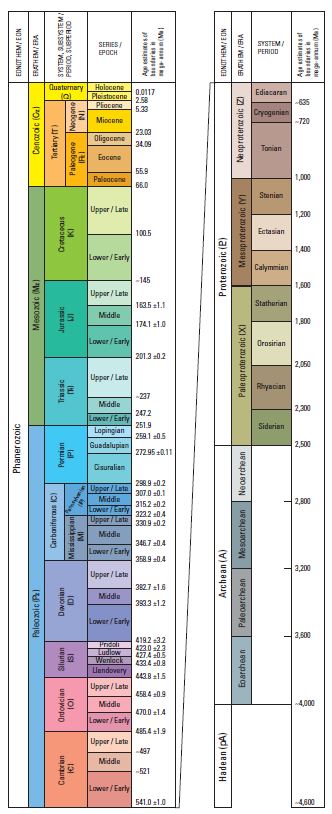
How this file works: Terms are added incrementally as each chapter passes through the pipeline. Every technical term, place-specific term, or specialized concept used in the encyclopedia appears here with a plain-language definition and a cross-reference to the chapter where it first appears or is most fully explained. Terms are alphabetical within thematic sections.
Last incorporated: Ch01, Ch02, Ch03, Ch04, Ch06, Ch07 (2026-05-27)
42.1 Geologic Terms
Alfisol — A soil order characterized by clay-enriched subsoil layers under deciduous or mixed forests. In Emery County, Alfisols occur at higher elevations on the Wasatch Plateau under conifer forests. (Ch01 §1.8)
Alluvial fan — A fan-shaped deposit of sediment built up where a stream exits a narrow canyon onto a broader plain. Buckhorn Draw and Little Wild Horse feature classic examples. (Ch01 §1.11)
Anticline — An arch-shaped fold in layered rock, with the oldest strata at the center. The San Rafael Swell is one of the largest exposed anticlines on the Colorado Plateau. (Ch01 §1.6; Ch02 §2.7)
Aridisol — The dominant soil order in Emery County’s low-elevation basins: thin topsoil over carbonate-rich subsoils formed under arid conditions. (Ch01 §1.8)
Conglomerate — A sedimentary rock composed of rounded pebbles, cobbles, or boulders cemented in a finer matrix. The Shinarump Conglomerate (Chinle Formation) and Buckhorn Conglomerate (Cedar Mountain Formation) are important Emery County examples. (Ch02 §2.4, §2.6)
Cross-bedding — Inclined layers within a rock unit, formed by wind or water depositing sediment on the slip faces of dunes or ripples. Spectacular cross-bedding is visible in the Navajo and Coconino sandstones. (Ch02 §2.3, §2.5)
Desert pavement — A surface layer of tightly packed pebbles and stones, formed as wind removes finer sediment. Found on benches near Ferron and Huntington. (Ch01 §1.10)
Entisol — A young soil with little profile development, common on slopes and recently deposited surfaces in Emery County. (Ch01 §1.8)
Eolian (aeolian) — Formed or deposited by wind. The Navajo Sandstone and Entrada Sandstone are eolian deposits; modern sand dunes near Roberts Roost Flats are active eolian features. (Ch01 §1.10; Ch02 §2.5)
Evaporite — A sedimentary deposit formed by the evaporation of saline water, including salt, gypsum, and potash. The Paradox Formation contains thick evaporite sequences. (Ch02 §2.3)
Formation — The basic unit of rock classification in stratigraphy: a body of rock with consistent characteristics that can be mapped across a region. (Ch02 §2.1)
Hogback — A narrow, steeply tilted ridge formed by the erosion of dipping resistant rock layers. The San Rafael Reef is a hogback of Navajo and Wingate sandstones. (Ch01 §1.7; Ch02 §2.7)
Hoodoo — A tall, thin column of rock formed by differential weathering of layers with varying hardness. Goblin Valley’s hoodoos form in the Entrada Sandstone. (Ch02 §2.5)
Hypsometry — The measurement of elevation distribution across a landscape. Hypsometric analysis reveals that ~50% of Emery County lies between 5,000 and 8,000 ft. (Ch01 §1.5)
Inceptisol — A moderately developed soil, more mature than an Entisol but lacking the clay enrichment of an Alfisol. Found on pinyon-juniper slopes. (Ch01 §1.8)
Karst — A landscape formed by the dissolution of soluble rocks (limestone, dolomite) by slightly acidic water, producing sinkholes, caves, and underground drainage. Occurs along the Wasatch Plateau margin in Emery County. (Ch01 §1.9)
Laccolith — A mushroom-shaped igneous intrusion that domes the overlying strata without breaking through to the surface. Oligocene-Miocene laccoliths in Emery County produced localized copper mineralization. (Ch02 §2.8)
Laramide Orogeny — A period of mountain-building (roughly 70–40 Ma) caused by the shallow subduction of the Farallon Plate beneath North America. Created the San Rafael Swell and the Rocky Mountains. (Ch01 §1.6; Ch02 §2.7)
Loess — Fine-grained, wind-deposited silt. Thin loess deposits on lee slopes near Castle Dale support distinctive vegetation. (Ch01 §1.10)
Mollisol — A soil order with a thick, dark, organic-rich surface layer, formed under grasslands or meadows. Found at the highest elevations on the Wasatch Plateau. (Ch01 §1.8)
Monocline — A step-like bend in otherwise horizontal rock layers. The San Rafael Swell’s flanks are monoclinal folds. (Ch01 §1.6; Ch02 §2.7)
Paleoflood terrace — A bench of sediment preserved above a modern stream channel, recording the level of ancient floods. Terraces up to 15 ft above modern channels line the Price and San Rafael rivers. (Ch01 §1.11)
Roll-front mineralization — A process by which uranium is concentrated along a chemical boundary in permeable rock as groundwater moves through organic-rich sediments. The mechanism behind uranium deposits in the Chinle Formation. (Ch02 §2.4)
Sabkha — A flat, salt-encrusted coastal plain in an arid environment. The Entrada Sandstone preserves ancient sabkha deposits. (Ch02 §2.5)
Sodium adsorption ratio (SAR) — A measure of sodium concentration relative to calcium and magnesium in soil or water. Elevated SAR on alluvial fans indicates saline conditions affecting agriculture. (Ch01 §1.8)
Stratigraphic column — A diagram showing the vertical sequence of rock units in a region, arranged from oldest (bottom) to youngest (top). (Ch02 §2.1)
Unconformity — A gap in the geologic record where rock layers were eroded or never deposited, representing missing time. The Moenkopi-Chinle contact is an unconformity. (Ch02 §2.4)
Ventifact — A rock shaped and polished by windblown sand. Found on desert pavements at Temple Mountain bench. (Ch01 §1.10)
42.2 Hydrologic & Water Terms
Acre-foot (af) — The volume of water that would cover one acre to a depth of one foot; approximately 325,851 gallons. Used to measure reservoir capacity and water rights. (Ch03 §3.8)
Aquifer — An underground layer of permeable rock or sediment that holds and transmits groundwater. The Colorado Plateau aquifer system underlies much of Emery County. (Ch03 §3.3)
Appropriation (water rights) — The legal right to divert and use a specific quantity of water, established under Utah’s prior-appropriation doctrine (“first in time, first in right”). (Ch03 §3.9)
Diversion — A structure or channel that redirects water from a natural stream to a canal or pipeline for irrigation or municipal use. (Ch03 §3.8, §3.9)
Dissolved solids (TDS) — The total concentration of minerals, salts, and metals dissolved in water, measured in milligrams per liter (mg/L). Green River water at the Emery County diversion averages 357 mg/L; agricultural return flows reach 4,170 mg/L. (Ch03 §3.6)
Discharge — The volume of water flowing past a point per unit of time, typically measured in cubic feet per second (cfs). (Ch03 §3.1, §3.2)
Ephemeral stream — A waterway that flows only during or immediately after precipitation events. Many Emery County washes — Little Wild Horse, Buckhorn Wash — are ephemeral. (Ch01 §1.4; Ch03)
Flash flood — A sudden, powerful surge of water through a normally dry channel, typically triggered by intense thunderstorms. A significant hazard in the San Rafael Swell’s slot canyons. (Ch02 §2.12; Ch03 §3.7; Ch04 §4.7)
Hanging garden — A lush assemblage of ferns, mosses, and wildflowers growing on a seep-fed cliff face, typically where a permeable sandstone layer meets an impermeable shale. Found in the San Rafael Swell. (Ch03 §3.5)
HUC-12 — A 12-digit Hydrologic Unit Code identifying a specific sub-watershed in the USGS watershed classification system. Emery County contains numerous HUC-12 units. (Ch01 §1.4)
Return flow — Water that re-enters a stream or aquifer after being diverted for irrigation, often carrying elevated dissolved solids from soil leaching. (Ch03 §3.6)
Salt loading — The process by which irrigation water dissolves salts from soil and rock and carries them into streams. Emery County contributes an estimated 15,700 tons/year of salt loading to the Green River. (Ch03 §3.6)
Seepage — The slow movement of water through soil or along canal beds. Canal seepage losses are a significant concern in Emery County’s irrigation infrastructure. (Ch03 §3.8)
Snowpack — Accumulated snow on the ground, measured as snow water equivalent (SWE). Approximately 95% of Utah’s water supply originates as snowpack. The Wasatch Plateau snowpack is Emery County’s primary water source. (Ch03 §3.11; Ch04 §4.5)
Spring — A natural point where groundwater reaches the surface. Emery County’s springs range from high-elevation perennial springs on the Wasatch Plateau to desert seeps in the San Rafael Swell. (Ch03 §3.4)
42.3 Geologic Formations (Emery County)
Listed from oldest to youngest. See Ch02 for full descriptions.
Hermosa Group (Pennsylvanian) — Marine carbonates and evaporites; includes the Paradox Formation (salt, potash, oil) and Honaker Trail Formation. Oldest rocks exposed in the San Rafael Swell interior. (Ch02 §2.3)
Coconino Sandstone (Permian) — Massive cross-bedded eolian sandstone, up to 715 ft thick. Preserved ancient sand dunes. (Ch02 §2.3)
Kaibab Limestone (Permian) — Marine limestone capping the Paleozoic section. Records the last Permian sea transgression. (Ch02 §2.3)
Moenkopi Formation (Triassic) — Reddish-brown mudstones with ripple marks and mudcracks. Forms the “chocolate ledges” around the San Rafael Swell. (Ch02 §2.4)
Chinle Formation (Triassic) — Colorful shales and conglomerates; includes the Shinarump Conglomerate, principal uranium ore host. Petrified wood common. (Ch02 §2.4)
Wingate Sandstone (Jurassic) — Sheer, rust-red cliff-forming eolian sandstone. (Ch02 §2.5)
Kayenta Formation (Jurassic) — Thin-bedded fluvial sandstones between the Wingate and Navajo. (Ch02 §2.5)
Navajo Sandstone (Jurassic) — Up to 2,000 ft of cross-bedded eolian sandstone. Forms slot canyon walls throughout the San Rafael Swell. (Ch02 §2.5)
Carmel Formation (Jurassic) — Marine limestones, siltstones, and gypsum from northern sea incursions. (Ch02 §2.5)
Entrada Sandstone (Jurassic) — Eolian and sabkha sandstone; forms Goblin Valley’s hoodoos. (Ch02 §2.5)
Morrison Formation (Jurassic) — Fluvial mudstones and sandstones; host rock of the Cleveland-Lloyd Dinosaur Quarry. 148–155 Ma. (Ch02 §2.5)
Cedar Mountain Formation (Cretaceous) — Variegated mudstones and sandstones; includes the Short Canyon Member and Buckhorn Conglomerate. (Ch02 §2.6)
Dakota Sandstone (Cretaceous) — Beach and nearshore sandstone marking the initial Western Interior Seaway transgression. (Ch02 §2.6)
Mancos Shale (Cretaceous) — Thick gray marine shale; includes the Ferron Sandstone Member and the Emery Sandstone Member (named for Emery County). (Ch02 §2.6)
Star Point Sandstone (Cretaceous) — Shoreface sandstone of the retreating Western Interior Seaway. (Ch02 §2.6)
Blackhawk Formation (Cretaceous) — Delta-plain and back-barrier deposits; host of Emery County’s coal seams. (Ch02 §2.6)
North Horn Formation (Cretaceous–Tertiary) — Fluvial and lacustrine deposits; notably prone to large-scale landslides. (Ch02 §2.8)
Green River Formation (Eocene) — Lacustrine deposits of ancient Lake Uinta; contains oil shale (kerogen). (Ch02 §2.8)
42.4 Geographic & Place Terms
Basin and Range Province — The physiographic province west of the Colorado Plateau, characterized by alternating mountain ranges and desert valleys formed by crustal extension. The western margin of Emery County shows Basin and Range influence. (Ch01 §1.2)
Book Cliffs — A major sandstone escarpment extending across northern Emery County, marking the edge of the Tavaputs Plateau. (Ch01 §1.2, §1.3)
Colorado Plateau — A vast region of relatively undeformed, flat-lying sedimentary rocks covering parts of Utah, Colorado, Arizona, and New Mexico. Emery County lies on its western margin. (Ch01 §1.2; Ch02 §2.1)
PLSS (Public Land Survey System) — The rectangular grid system used to describe land ownership in the western United States, based on townships, ranges, and sections tied to a principal meridian and baseline. Emery County’s boundaries are defined by PLSS lines tied to the Salt Lake Meridian. (Ch01 §1.1)
San Rafael Reef — The steeply tilted eastern limb of the San Rafael Swell, forming a dramatic wall of Navajo and Wingate sandstone hogbacks visible from I-70. (Ch02 §2.7)
San Rafael Swell — A massive dome-shaped anticline (~75 × 40 miles) in Emery County, exposing rocks from the Pennsylvanian to the Cretaceous. The county’s defining geologic and geographic feature. (Ch01 §1.7; Ch02 §2.7)
Tavaputs Plateau — The elevated tableland north of the Book Cliffs in northern Emery County. (Ch01 §1.2)
Wasatch Plateau — The high, forested plateau along Emery County’s western boundary, reaching over 10,700 ft. The county’s primary water source. (Ch01 §1.3; Ch03 §3.1; Ch04 §4.3)
Western Interior Seaway — A shallow ocean that split North America from the Gulf of Mexico to the Arctic during the Late Cretaceous (~95–70 Ma). Its deposits form the Mancos Shale and Mesaverde Group. (Ch02 §2.6)
42.5 Biological & Ecological Terms
BLM Sensitive Species — A category of plants and animals identified by the Bureau of Land Management as needing special management attention to prevent listing under the Endangered Species Act. Emery County hosts several BLM Sensitive Species, including bald eagle wintering populations and burrowing owls. (Ch06 §6.10)
Colorado pikeminnow (Ptychocheilus lucius) — North America’s largest native minnow, federally listed as endangered (1967/1973). Found in the Green River through Emery County. (Ch03 §3.10; Ch06 §6.6)
Cooperative Wildlife Management Unit (CWMU) — A program administered by Utah’s Division of Wildlife Resources in which private landowners enter agreements to manage hunting access on their property in exchange for permits. Several CWMUs operate in Emery County’s mountain habitats. (Ch06 §6.11)
Crepuscular — Active primarily at dawn and dusk. Many Emery County mammals (coyote, mule deer, mountain lion) are crepuscular, especially during hot summer months. (Ch06 §6.3)
Diel activity pattern — The 24-hour pattern of when a species is active (diurnal = daytime, nocturnal = nighttime, crepuscular = dawn/dusk, cathemeral = irregular). Important for species inventory survey timing. (Ch06 §6.3)
Endangered Species Act (ESA) — The 1973 federal law that lists species as Threatened or Endangered and prescribes protection measures. Several Emery County species are ESA-listed, including the Colorado pikeminnow and razorback sucker. (Ch06 §6.6; Ch03 §3.10)
Endemic — A species found only within a specific geographic area. The Colorado Plateau has notable endemic species, though most Emery County wildlife is more broadly distributed. (Ch06 §6.4)
Fremont cottonwood (Populus fremontii) — The dominant riparian tree along Emery County’s streams and rivers. (Ch01 §1.4; Ch06 §6.5)
Generalist — A species that uses a wide range of habitats and food sources. Coyotes, ravens, and mule deer are classic generalists thriving in Emery County’s varied landscapes. (Ch06 §6.4)
Indicator species — A species whose presence, abundance, or health reflects broader environmental conditions. The leopard frog and Colorado pikeminnow serve as indicators of Emery County riparian health. (Ch06 §6.6)
Migration corridor — A landscape pathway used by wildlife to move between seasonal ranges. The Wasatch Plateau-Castle Valley elk migration is among the most monitored in Utah. (Ch06 §6.7)
Narrowleaf willow (Salix exigua) — A shrub-form willow common in riparian corridors. (Ch01 §1.4; Ch06 §6.5)
Razorback sucker (Xyrauchen texanus) — A large native sucker fish, federally listed as endangered (1991). Found in the Green River. (Ch03 §3.10; Ch06 §6.6)
Riparian obligate — A species that requires riparian (streamside) habitat for some or all of its life cycle. Yellow warbler, Wilson’s warbler, and Lucy’s warbler are Emery County riparian obligates. (Ch06 §6.5)
Specialist — A species adapted to a narrow range of habitats or food sources. Bighorn sheep — adapted to steep, broken cliff terrain — are classic Emery County specialists. (Ch06 §6.4)
Species of Greatest Conservation Need (SGCN) — A category in Utah’s Wildlife Action Plan identifying species whose populations or habitats warrant focused conservation attention. Emery County hosts dozens of SGCN species. (Ch06 §6.10)
Threatened & Endangered (T&E) — A grouping that combines federally Threatened species (likely to become endangered) and Endangered species (in danger of extinction). T&E lists drive much of Emery County’s federal land-use planning. (Ch06 §6.6)
Trophic level — A position in a food web, from primary producers (plants) through herbivores, mesopredators, and apex predators. Mountain lions and golden eagles occupy Emery County’s apex trophic levels. (Ch06 §6.9)
Ungulate — A hoofed mammal. Emery County’s native ungulates include mule deer, elk, pronghorn, bighorn sheep, and (reintroduced) moose. (Ch06 §6.7)
Utah Division of Wildlife Resources (UDWR or DWR) — The state agency responsible for managing fish, wildlife, and habitat. DWR’s Southeastern Region office in Price covers Emery County. (Ch06 §6.11)
Utah Wildlife Action Plan (UWAP) — A statewide conservation strategy required by federal State Wildlife Grants funding, identifying species and habitats of conservation concern. Last major revision 2015 with ongoing updates. (Ch06 §6.10)
Wildlife Management Area (WMA) — Land owned or managed by DWR primarily for wildlife habitat and public hunting/fishing access. The Cottonwood Creek WMA is a notable Emery County example. (Ch06 §6.11)
42.6 Climate & Weather Terms
Atmospheric pressure — The weight of the air column above a point, measured in millibars (mb), hectopascals (hPa), or inches of mercury (in. Hg). Standard sea-level pressure is 1013.25 mb; Castle Dale at 5,600 ft typically reads ~830 mb. (Ch04 §4.2)
BWk (Köppen cold-arid) — The dominant Köppen climate classification across Emery County’s lower elevations: cold desert. Annual precipitation is less than half of potential evapotranspiration, and the coldest-month mean is below freezing. (Ch04 §4.1)
Climate normals (30-year) — A standardized 30-year average of climate variables (temperature, precipitation, snowfall) published by the National Centers for Environmental Information. The current normals span 1991–2020. (Ch04 §4.2)
Continentality — The degree to which a location’s climate is influenced by distance from large bodies of water. Emery County, far from the Pacific Ocean, has high continentality — large diurnal and seasonal temperature swings. (Ch04 §4.2)
COOP (Cooperative Observer Program) — The National Weather Service network of volunteer weather observers, providing daily temperature and precipitation records since the 1890s. Emery County has long-running COOP stations at Green River, Castle Dale, Ferron, and Hanksville. (Ch04 §4.2)
Csb / Dsb (Köppen) — Köppen climate classifications for Emery County’s high-elevation zones: Csb = warm-summer Mediterranean (rare on the plateau); Dsb = humid continental with cool summers and snowy winters, typical of the upper Wasatch Plateau above 9,000 ft. (Ch04 §4.1)
Diurnal temperature range — The difference between a day’s high and low temperature. Emery County’s clear skies and low humidity produce diurnal ranges often exceeding 30°F at low elevations and 35–40°F in summer. (Ch04 §4.3)
Evapotranspiration (ET) — The combined loss of water to the atmosphere through soil evaporation and plant transpiration. Reference ET in Castle Valley typically exceeds 50 inches annually, far above the ~7-inch precipitation total. (Ch04 §4.6)
Frost-free period (growing season) — The number of days between the last spring freeze and the first fall freeze. Castle Valley averages 140–160 frost-free days; the upper Wasatch Plateau drops below 80. (Ch04 §4.4)
Growing Degree Days (GDD) — A cumulative measure of heat available for crop growth, summing daily temperatures above a base threshold (commonly 50°F). Used to predict crop maturity and pest emergence. (Ch04 §4.4)
Inversion (temperature inversion) — A condition in which a warm air layer sits above colder air near the ground, trapping pollutants and moisture. Castle Valley experiences strong winter inversions when calm, clear nights allow cold-air pooling. (Ch04 §4.3)
Köppen climate classification — A widely used system for grouping climates by temperature and precipitation patterns, developed by Wladimir Köppen in 1900 and refined since. Emery County contains BWk (cold desert), BSk (cold steppe), Dsb (humid continental), and small Csb pockets. (Ch04 §4.1)
Lapse rate — The rate at which temperature decreases with elevation. The environmental lapse rate averages about 3.5°F per 1,000 ft; Emery County’s 5,000-ft elevation range produces ~17°F mean-temperature differences across the county. (Ch04 §4.3)
Microclimate — A small-scale climate distinct from its surroundings, produced by slope aspect, vegetation, soil, or water features. North-facing canyon walls in the San Rafael Swell support cool-microclimate plant communities. (Ch04 §4.8)
Monsoon (North American) — A summer pattern in which moisture flows north from the Gulf of California and Gulf of Mexico, producing afternoon thunderstorms across the Southwest from roughly mid-July through mid-September. Emery County receives 20–40% of its annual precipitation during the monsoon. (Ch04 §4.5)
Orographic precipitation — Rain or snow produced when air is forced upward over a mountain barrier, cooling and releasing moisture. The Wasatch Plateau is the dominant orographic precipitation source for Emery County. (Ch04 §4.5)
Palmer Drought Severity Index (PDSI) — A long-term index of meteorological drought combining temperature and precipitation departures. PDSI values for Utah Climate Division 6 (which includes Emery County) routinely reach −4 (extreme drought) during multi-year dry spells. (Ch04 §4.7)
Plant hardiness zone — A USDA classification of minimum winter temperatures used to guide plant selection. Emery County spans zones 5b–7a, with Green River the warmest and upper Wasatch Plateau the coldest. (Ch04 §4.4)
Precipitation gradient — The spatial variation in average precipitation across a landscape. Emery County’s gradient runs from ~6 inches/year at Green River to over 30 inches/year on the high Wasatch Plateau — one of the steepest county-scale gradients in Utah. (Ch04 §4.5)
Rain shadow — The dry zone on the leeward (downwind) side of a mountain range, produced when air descends after losing moisture on the windward side. Castle Valley sits in the rain shadow of the Wasatch Plateau. (Ch04 §4.5)
SNOTEL (Snow Telemetry) — An automated network of high-elevation snowpack monitoring stations operated by the USDA Natural Resources Conservation Service. Buck Flat, Mammoth-Cottonwood, and Seeley Creek SNOTEL stations monitor Emery County’s water supply. (Ch04 §4.5; Ch03 §3.11)
Standardized Precipitation Index (SPI) — A drought index based solely on precipitation departures over selected time scales (1, 3, 6, 12, 24, 48 months). The SPI complements PDSI by isolating precipitation effects from temperature. (Ch04 §4.7)
Sublimation — The direct conversion of snow or ice to water vapor without melting. Emery County’s clear, dry winter air drives significant sublimation losses from the Wasatch Plateau snowpack — a complication for water-supply forecasting. (Ch04 §4.5; Ch03 §3.11)
Wind chill — A measure of perceived cold combining air temperature and wind speed. Castle Valley’s strong winter winds can drop wind-chill values 20–30°F below the actual temperature. (Ch04 §4.3)
42.7 Astronomy & Night Sky Terms
Apparent magnitude — A logarithmic measure of how bright a celestial object appears from Earth. Smaller (or more negative) numbers indicate brighter objects. The Sun is magnitude −26.7; the faintest stars visible to the naked eye in pristine skies are magnitude ~7. (Ch07 §7.2)
Astronomical twilight — The period when the Sun is between 12° and 18° below the horizon. The sky is dark enough for most astronomical observations, but the faintest galaxies and nebulae require true astronomical night (Sun more than 18° below horizon). (Ch07 §7.3)
Bortle scale — A nine-class scale of night-sky darkness developed by John E. Bortle in 2001. Class 1 represents the darkest skies on Earth; Class 9 represents inner-city skies. Most of Emery County’s San Rafael Swell falls in Class 1–2. (Ch07 §7.4; Ch35 §35.4)
Celestial equator — The projection of Earth’s equator onto the sky. Stars on the celestial equator rise due east and set due west everywhere on Earth. (Ch07 §7.2)
Circumpolar — Describes stars or constellations that never set as seen from a given latitude. At Emery County’s ~39° N latitude, Ursa Major, Ursa Minor, Cassiopeia, Cepheus, and Draco are circumpolar. (Ch07 §7.2)
Civil twilight — The period when the Sun is between 0° and 6° below the horizon. The sky retains noticeable illumination and outdoor activities can usually continue without artificial light. (Ch07 §7.3)
Conjunction — An apparent close approach of two celestial objects (typically the Moon, planets, or bright stars) in the sky. A great conjunction of Jupiter and Saturn occurred December 21, 2020. (Ch07 §7.6)
Ecliptic — The apparent annual path of the Sun across the celestial sphere, also the plane in which the planets orbit. Visible from Emery County as the line along which the planets and zodiacal constellations appear. (Ch07 §7.2)
Gegenschein — A very faint glow visible opposite the Sun in the night sky, caused by sunlight backscattered from interplanetary dust. Detectable only in true Bortle 1 conditions. (Ch07 §7.5)
International Dark Sky Park (IDSP) — A designation by DarkSky International (formerly the International Dark-Sky Association) for parks that meet rigorous standards for night-sky preservation and lighting. Goblin Valley State Park was certified in 2016. (Ch07 §7.7; Ch35 §35.2)
Light pollution — Excessive, misdirected, or obtrusive artificial light that diminishes the visibility of the night sky and disrupts ecosystems. The Kyba et al. 2023 Science paper estimated global skyglow is brightening ~10% per year. (Ch07 §7.7; Ch35 §35.5)
Limiting magnitude — The faintest star visible to the unaided eye under given sky conditions. Bortle 1 skies allow limiting magnitudes of 7.6–8.0; suburban skies typically limit to magnitude 4. (Ch07 §7.4)
Milky Way — The galaxy that contains our Solar System, visible from Earth as a luminous band of stars and dust crossing the sky. Visible to the naked eye throughout Emery County, with the galactic core best seen in summer. (Ch07 §7.5)
Nautical twilight — The period when the Sun is between 6° and 12° below the horizon. Bright stars and the horizon can both be discerned — historically used for navigation. (Ch07 §7.3)
Naked-eye observation — Astronomical viewing without binoculars or a telescope. Emery County’s dark skies make naked-eye observation of the Andromeda Galaxy, meteor showers, and faint Milky Way structure possible. (Ch07 §7.4)
Opposition — The configuration in which a planet outside Earth’s orbit appears opposite the Sun in the sky, making it visible all night and at its closest and brightest. Mars reaches opposition every ~26 months. (Ch07 §7.6)
Sidereal time — Time measured by the rotation of Earth relative to the stars (as opposed to solar time, measured against the Sun). A sidereal day is about 23 hours 56 minutes. (Ch07 §7.2)
Sky Quality Meter (SQM) — A handheld device that measures the brightness of the night sky in magnitudes per square arcsecond. Readings of ~21.75+ indicate Bortle 1 skies; ~21.6 marks the Bortle 1/2 boundary; readings around 18 indicate suburban skies. (Bortle class boundaries are approximate.) (Ch07 §7.4; Ch35 §35.4)
Star party — An organized gathering of amateur astronomers to share telescopes and observe together. Goblin Valley State Park and Capitol Reef host regular ranger-led star parties. (Ch07 §7.7; Ch35 §35.7)
Synodic period — The time between successive identical configurations of two celestial bodies as seen from Earth. The Moon’s synodic period (29.5 days) governs the lunar phase cycle. (Ch07 §7.6)
Zodiacal light — A faint, triangular glow visible above the western horizon after evening twilight in spring or above the eastern horizon before morning twilight in fall. Caused by sunlight scattering off interplanetary dust along the ecliptic. (Ch07 §7.5)
Term Statistics
| Statistic | Value |
|---|---|
| Total terms defined | 132 |
| Chapters incorporated | Ch01, Ch02, Ch03, Ch04, Ch06, Ch07 |
| Geologic terms | 28 |
| Hydrologic terms | 14 |
| Formation entries | 18 |
| Geographic/place terms | 9 |
| Biological/ecological terms | 22 |
| Climate & Weather terms | 21 |
| Astronomy & Night Sky terms | 20 |
Next update: after Ch08 (or next batch chapter) completes Phase 7. Ch05 (Flora Zones) terms deferred pending Ch05 sources file.