Part 5 · Field Guide
Night Sky Tourism
Dark skies as Emery County's emerging tourism resource: Goblin Valley State Park's 2016 International Dark Sky designation, Bortle Class 1-2 skies across the San Rafael Swell, ranger-led star parties, the 1874 and 1882 Venus transits visible from the county, light-pollution trends from Kyba et al. (2023), and the practical field-guide essentials — seasonal viewing windows, equipment, photography techniques, and the public-lands etiquette that keeps the county's night sky among the darkest in the lower 48.
Ch35 — Night Sky Tourism
35.1 Introduction — A County of Dark Skies
On a moonless night in the heart of the San Rafael Swell, the band of the Milky Way is unmistakable — a soft river of light arching from horizon to horizon, dense with detail, with the central bulge of the galaxy a visible glow above the southwestern skyline in summer. Most American visitors have never seen this. Roughly 80 percent of North Americans live under skies bright enough that the Milky Way is invisible from where they sleep. In Emery County, the opposite is true: the Milky Way is a near-constant feature of clear nights, and what most of the country experiences as a special trip to a remote destination is, here, an ordinary feature of stepping outside the truck.
Emery County’s combination of low population density (roughly 0.9 persons per square mile in much of the Swell), high elevation (lifting observers above the densest atmosphere), and very dry desert air (transparent and stable) produces some of the darkest, clearest skies in the lower 48 states. The county hosts one of Utah’s more than twenty-five certified International Dark Sky Places (as of early 2026) — Goblin Valley State Park — and a vast surrounding landscape that, while uncertified, offers conditions equal to any Dark Sky Park anywhere in the world.
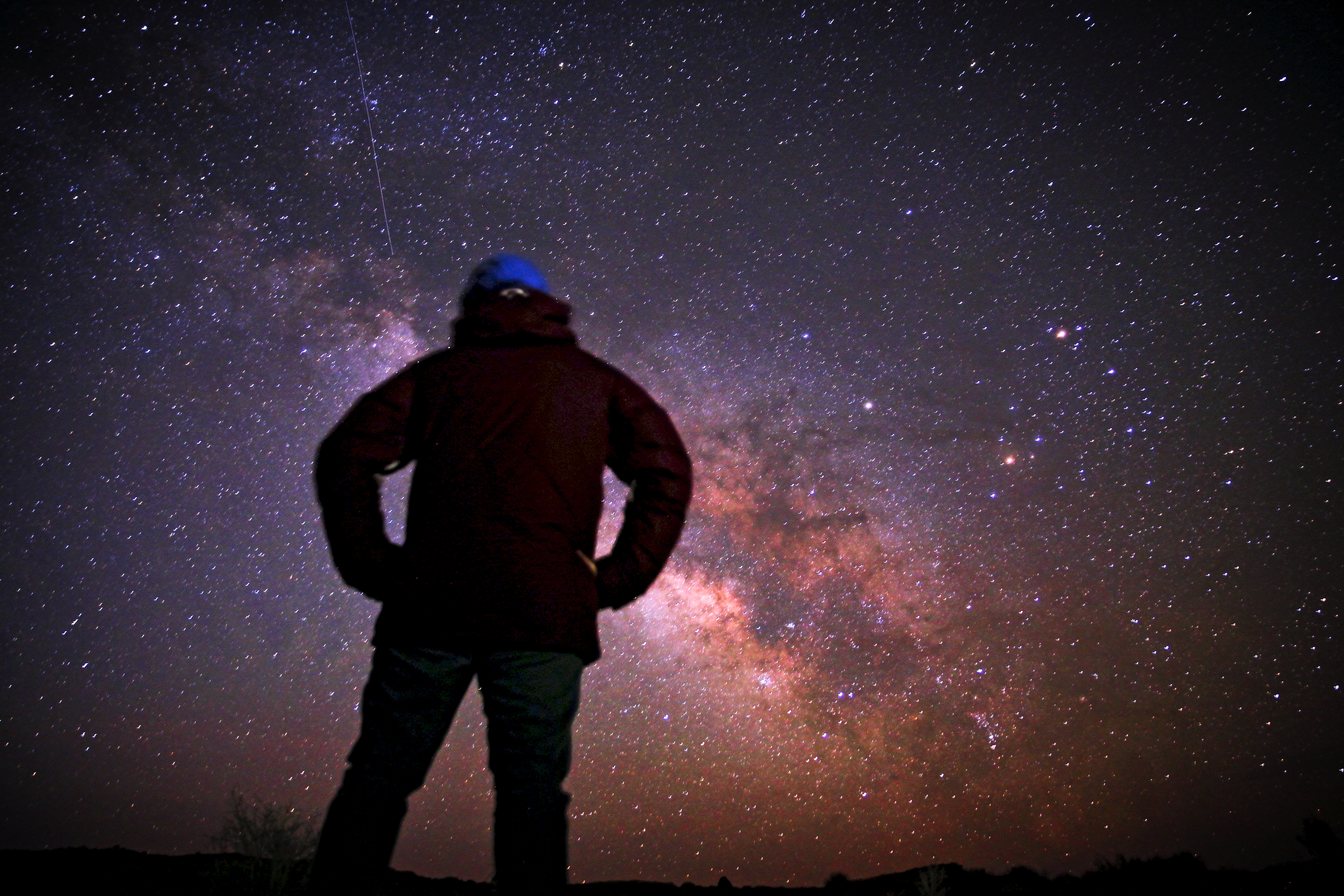
This chapter is a field guide to that night sky. It covers where to go in the county to find the darkest viewing, when to go for major celestial events, what equipment helps and what is unnecessary, the rules that govern outdoor lighting in a Dark Sky Park, and a brief history of how humans have looked up at the same sky from this place for at least 12,000 years. Beginners and experienced astronomers alike should find it useful as a planning tool and a reading companion to time spent under the stars.
Did You Know? Roughly 80 percent of North Americans cannot see the Milky Way from where they live, due to artificial light pollution. In Emery County, the Milky Way is visible from any reasonably dark spot on any clear, moonless night — a feature of ordinary life that, a few generations ago, would have been universal.
35.2 Goblin Valley State Park — International Dark Sky Park
Goblin Valley State Park, in the southeastern corner of Emery County off SR-24 about 35 miles south of I-70, became an International Dark Sky Park in 2016. The certification, granted by DarkSky International (formerly the International Dark-Sky Association), followed a two-year application process during which park staff inventoried all exterior lighting, retrofitted fixtures to shielded warm-temperature LEDs, established a curfew on non-essential lighting, and built out an astronomy education program.
Goblin Valley was the second Utah State Park to earn the designation, following Dead Horse Point State Park, which was certified earlier the same year. The skies above Goblin Valley typically rate Bortle Class 1 to Class 2 — the darkest two categories on a nine-class scale, equivalent to skies that astronomers travel internationally to observe.
The park’s geological setting amplifies the night-sky experience. The thousands of hoodoo formations that fill the valley floor — Jurassic Entrada Sandstone weathered into mushroom-shaped pillars (see Ch02: Deep-Time Geology ↗ 1 Ch02: Deep-Time Geology A billion-year journey through stone: Precambrian foundations, Paleozoic seas, Mesozoic dinosaurs, and recent tectonics. Read chapter → ) — provide an extraordinary foreground for astrophotography. A photograph of the Milky Way rising over the goblins is one of the signature images of southern Utah astrotourism.
Astronomy Programming. Goblin Valley offers ranger-led astronomy programs on most Saturday nights from late spring through early fall, with additional special programs around new-moon weekends, the Perseid meteor shower in August, and the annual Heritage Starfest event (timing varies year to year — check current schedules). Programs typically include a constellation tour, telescope viewing of seasonal targets, and an introduction to the science of dark-sky preservation. Programs are free with park admission and require no reservation.
Practical Notes.
- Camping. The park has a small campground (about 25 sites) and two yurts that are highly popular and book months in advance. Reservations open online via Utah State Parks; back-to-back nights during meteor showers are typically sold out. Dispersed BLM camping is available on adjacent lands, though specific designated sites should be confirmed via the Hanksville and Price Field Offices.
- Fees. Park admission applies; a Utah State Parks annual pass is good value for repeat visitors. (See Ch31 — Parks & Monuments for current fee structure.)
- Lighting. All park lighting after dark is red, amber, or fully shielded white at low color temperature. Visitors are asked to use red-light headlamps and avoid white-light flashlights in the public areas of the park.
35.3 The Swell Beyond Goblin Valley — Uncertified but World-Class
Goblin Valley’s designation makes formal what is true of essentially the entire San Rafael Swell: under most cloud-free moonless conditions, the skies are as dark as any officially certified Dark Sky Park. The Wedge Overlook, Buckhorn Wash, Cottonwood Wash, and the Mexican Mountain area all offer Bortle Class 1–2 conditions. The same is true of the I-70 corridor as it crosses the Swell from the San Rafael Reef westward toward the Wasatch Plateau — rest stops and pullouts along this stretch make impromptu astronomy easy.
Several factors keep the Swell exceptionally dark:
- Low population. Emery County’s total population is roughly 10,000, concentrated in a narrow strip of towns along SR-10 north of the Swell. The Swell itself has no permanent residents and few overnight visitors.
- Federal land management. The BLM-administered San Rafael Swell Recreation Area, designated by the 2019 Dingell Act, has no permanent fixed lighting beyond a handful of small interpretive signs at trailheads.
- Distance from major light sources. The closest significant urban skyglow comes from Price (population ~8,000, Carbon County) to the north — visible as a faint dome on the northern horizon from the Wedge Overlook but not bright enough to impact zenith viewing. The Wasatch Front (Salt Lake / Provo metropolitan area, ~150 miles west-northwest) is faintly perceptible only on the clearest nights from the highest plateau viewpoints.
The result is that any reasonably accessible dirt-road pullout in the interior of the Swell can serve as a world-class observing site. For visitors uninterested in formal parks, the Swell is a continuous dark-sky reserve in everything but name.
35.4 The Bortle Scale and Light-Pollution Context
The Bortle scale, introduced by amateur astronomer John E. Bortle in a 2001 Sky & Telescope article, gives a common vocabulary for describing night-sky darkness (see Ch07: Night Skies & Astronomy ↗ 1 Ch07: Night Skies & Astronomy Dark skies and celestial wonders: constellations, milky way viewing, and the astronomical heritage of the high desert. Read chapter → ). It runs from Class 1 (excellent dark-sky site — pristine; zodiacal light prominent; the Milky Way casts a faint shadow) to Class 9 (inner-city sky — only the Moon, planets, and a handful of the brightest stars visible).
Most of Emery County falls in Class 1–2 territory. By comparison:
- Salt Lake City suburbs: typically Class 7.
- Provo: typically Class 6–7.
- Price, Utah: about Class 4 within the town; Class 2 within five miles.
- Green River town: about Class 4 in town; Class 2 immediately outside.
- The interior San Rafael Swell: Class 1–2 across the great majority of its area.
The practical consequence: Emery County allows observers to see the Andromeda Galaxy (M31) with the naked eye, the band of the Milky Way splitting into the Cygnus rift and Sagittarius cloud, the zodiacal light (a faint pyramid of sunlight scattered by interplanetary dust, visible after sunset in spring and before sunrise in autumn), and faint deep-sky objects through modest amateur telescopes that would be lost in any urban setting.
The skyglow conditions in Emery County are not static. Light pollution worldwide is increasing substantially: citizen-science observations analyzed by Kyba et al. (2023, Science) found apparent night-sky brightness increasing at roughly 9.6 percent per year, driven primarily by the spread of LED outdoor lighting. Even at this rate, Emery County’s interior should remain among North America’s darkest places for the foreseeable future — but stewardship matters. (See §35.9 below.)
35.5 A Year of Sky-Watching — The Annual Calendar
A patient observer can find something to watch in the Emery County sky any night of the year. The calendar below highlights the main events.
Meteor Showers (peak nights; visible from any dark site in the county):
| Shower | Peak | Notes |
|---|---|---|
| Quadrantids | Jan 3–4 | Brief peak (6 hours); cold-weather viewing |
| Lyrids | Apr 22–23 | Moderate rates; pleasant temperatures |
| Eta Aquariids | May 5–6 | Halley’s Comet debris; predawn viewing |
| Perseids | Aug 12–13 | Signature summer shower; warm nights; up to 60–100 meteors/hour |
| Orionids | Oct 21–22 | Halley’s Comet debris (second pass); cool temperatures |
| Leonids | Nov 17–18 | Variable rates; occasional storms (last storm 1999/2001) |
| Geminids | Dec 13–14 | Brightest meteors of the year; cold viewing |
The Milky Way Visibility Window. The galactic center (in Sagittarius) is below the horizon from November through February (visible from Emery County’s latitude only briefly at dawn in late winter). It rises in the southeast in April, transits the southern meridian around midnight in June and July, and sets in the southwest by late October. May through September is the prime Milky Way viewing season, with June through August being peak.
Planets. Mercury, Venus, Mars, Jupiter, and Saturn are all visible to the naked eye through their respective synodic cycles. Jupiter and Saturn are reliable telescope targets year-round (alternating mornings/evenings); Mars varies dramatically in apparent size between oppositions (about every two years).
Aurora. The aurora borealis is rare but possible at Emery County’s latitude (~39° N). Strong solar storms (G3 or greater) occasionally produce visible aurora; the May 2024 G5 event was visible from Utah at unusual brightness. Monitor NOAA’s space-weather alerts during high solar-activity years.
Constellations by Season.
- Winter (Dec–Feb): Orion dominates; the Pleiades, Taurus, Auriga, Gemini overhead.
- Spring (Mar–May): Leo, Boötes, Virgo, Coma Berenices (galaxy cluster country).
- Summer (Jun–Aug): Cygnus, Aquila, Lyra, Sagittarius, Scorpius — Milky Way overhead.
- Fall (Sep–Nov): Pegasus, Andromeda, Cassiopeia, the autumn galaxy fields.
Catch the Perseids: A Meteor-Shower Campout
On the night of August 12–13, drive to a dark Emery County overlook, lie back with a pad and a red headlamp, give your eyes 20 minutes to dark-adapt, and count meteors — a dark Swell sky can deliver 60 to 100 an hour at the Perseid peak.
What you'll need:
A reclining chair or foam pad and sleeping bag, A red-light headlamp, Warm layers (desert nights cool fast), Snacks and patience
35.6 Equipment and Apps
Sky-watching in Emery County rewards careful preparation but does not require expensive equipment. The most important “tools” cost nothing: dark adaptation, patience, and a clear horizon.
Essentials.
- Red-light headlamp. White light destroys dark-adaptation in seconds; red light preserves it for hours. A headlamp with a switchable red mode is the single most important piece of equipment.
- Warm clothing. Even summer desert nights cool dramatically once the sun sets. October through April typically requires insulated layers.
- Reclining lawn chair, sleeping pad, or zero-gravity chair. Astronomy is largely a neck-craning activity; horizontal support transforms the experience.
- Star chart or app. A printed chart (Sky & Telescope monthly star chart, free download) or an app — see below.
Binoculars. A pair of 7×50 or 10×50 binoculars opens up the Milky Way’s star clouds, the Andromeda Galaxy, the Pleiades, Jupiter’s moons (you can resolve all four Galilean moons with steady 10× binoculars), and dozens of star clusters. Binoculars are by far the most cost-effective astronomical instrument.
Telescopes. A telescope is not essential but rewards committed observers. Recommended entry-level options:
- 8-inch Dobsonian — the best beginner “serious” telescope. Affordable (about $500–$600 new), capable of resolving Saturn’s rings, banded detail on Jupiter, the Orion Nebula’s structure, the Andromeda Galaxy’s companions, and hundreds of deep-sky objects.
- 4-inch refractor — portable, lower magnification, excellent for wide-field views.
- 6-inch SCT (Schmidt-Cassegrain) — versatile, computer-driven Go-To options available.
Apps (smartphone).
- Stellarium Mobile (free with paid premium tier) — comprehensive sky simulation; nearly the only app most observers need.
- SkySafari (paid) — deeper object database; favored by serious deep-sky observers.
- Sky Map (free, Android) — simple constellation identification.
- ISS Detector / Heavens-Above (free) — predicts visible International Space Station passes and bright satellite passes.
- PhotoPills (paid) — astrophotography planning, Milky Way and Moon position by date and location.
Smartphone Cameras. Modern Pixel and iPhone phones with Night mode can capture astonishing handheld Milky Way photographs in Bortle 1 conditions. The technology improves yearly; experiment with what your phone can do before investing in dedicated camera gear.
Table 35-B — Observing Equipment by Experience Level
| Level | Core kit | Adds | Approx. entry cost |
|---|---|---|---|
| Beginner | Red-light headlamp; warm layers; reclining chair or pad; free star chart or Stellarium app | Smartphone Night-mode photos | Minimal |
| Intermediate | 7×50 or 10×50 binoculars; printed monthly chart; ISS/satellite pass app | PhotoPills or SkySafari for planning | Low (binoculars) |
| Committed visual | 8-inch Dobsonian (~$500–600 new) or 4-inch refractor; observing stool | 6-inch SCT with Go-To as alternative | ~$500–600 |
| Astrophotography | DSLR/mirrorless + 14–24mm f/2.8 + sturdy tripod | Compact tracker (e.g., Sky-Watcher Star Adventurer); stacking software (Sequator, DeepSkyStacker, StarStaX — free) | Camera-dependent |
Equipment and price figures per §35.6; prices are chapter-date estimates, verify before purchase.
The Binocular Sky Hunt
- □ The band of the Milky Way — a soft, uneven river of light; look south in summer
- □ The Andromeda Galaxy (M31) — a faint fuzzy oval; the most distant thing your eyes can see unaided
- □ The Pleiades — a tight little dipper of blue stars in Taurus (best in winter)
- □ Jupiter's four moons — steady your binoculars on a rail to line up all four Galilean moons
- □ The Orion Nebula — a misty patch in the 'sword' hanging below Orion's belt (winter)
- □ A satellite crossing the sky — a steady moving 'star' that never blinks
- □ The International Space Station — brighter and faster than any satellite; use the ISS Detector app to time it
- □ A shooting star — patience required
Share your finds! #EmeryCountyExplorer
35.7 Astrophotography in Emery County
The combination of dark skies and dramatic foreground geology makes Emery County one of the great astrophotography destinations in North America. The Milky Way over Goblin Valley’s hoodoos, star trails above the Buckhorn Swinging Bridge, the Andromeda Galaxy framed against a sandstone wall — these images have become a recognizable visual signature of the county.
Wide-field Milky Way Photography. The most accessible serious astrophotography. Required equipment: DSLR or mirrorless camera, a fast wide-angle lens (14–24mm, f/2.8 or wider), and a sturdy tripod. Suggested settings as a starting point:
- ISO 3200–6400
- Aperture wide open (f/2.8 or faster)
- Exposure 20–25 seconds (longer produces star trailing without a tracker)
- Manual focus on a bright star, using live-view magnification
Stacking multiple frames in software (Sequator, Starry Landscape Stacker, or DeepSkyStacker) reduces noise and reveals fainter detail.
Star Trails. Long-exposure star trails capture the Earth’s rotation. Method: a series of 30-second exposures over 30 minutes to several hours, stacked in software (StarStaX is free and excellent). Polaris in the resulting image is the still center; everything else rotates around it.
Tracked Deep-Sky Imaging. Serious astrophotography uses a motorized equatorial tracking mount to compensate for Earth’s rotation. The Sky-Watcher Star Adventurer and similar compact trackers are popular entry points. Targets accessible to a wide-field tracked rig from Emery County include the Andromeda Galaxy, the North America Nebula, the Heart and Soul nebulae, the Pleiades, the Rosette Nebula, and many more.
Astrophotography Ethics. All the wildlife-watching ethics in Ch34: Wildlife Watching ↗ 5 Ch34: Wildlife Watching A field guide to wildlife observation across Emery County's three habitat zones - the Wasatch Plateau high country, the ... Read chapter → apply at night too. Use red lights; do not park where headlights illuminate other observers’ fields of view; do not climb on geological features for “the shot.”
35.8 Indigenous and Historical Sky-Watching
Humans have looked up at the same sky from Emery County for at least 12,000 years. The Paleo-Indian, Archaic, Fremont, and Ute peoples whose archaeological record dominates the county’s first eight chapters of human history all shared the night sky over the Swell, and the dark conditions they experienced are essentially what visitors experience today.
Archaeoastronomy in Rock Art. Some rock-art panels in and adjacent to the San Rafael Swell contain motifs that have been interpreted by archaeoastronomers as astronomical: solstice-aligned light-and-shadow effects, motifs resembling supernovae, possible lunar standstill markers. The interpretation of specific panels is contested, and the field of archaeoastronomy is unevenly received within mainstream archaeology. Out of respect for the original communities whose work this is, this encyclopedia does not endorse specific astronomical claims about specific panels; readers interested in the question are referred to Anna Sofaer’s work at Chaco Canyon (a related-but-different cultural context) and to current published research on Fremont rock art (see Ch09: Fremont Culture ↗ 2 Ch09: Fremont Culture The most visible ancient culture in Emery County: Fremont pit houses, pottery, irrigation, and the spectacular rock art ... Read chapter → ).
Pioneer-Era Observation. Castle Dale, Ferron, and Huntington settlers in the 1880s observed the same night sky we do today. Halley’s Comet at its 1910 return was a major regional event; Emery County newspapers from the period (consult Ch37: Archives, Museums & Libraries ↗ 6 Ch37: Archives, Museums & Libraries The working back-of-the-book for Emery County research: the County Archives in Castle Dale, the Museum of the San Rafael... Read chapter → for archive guidance) carry brief notices. The 1874 and 1882 transits of Venus would have been visible from the county had observers known to look.
Modern Astronomy in Utah. Utah has a strong amateur and professional astronomy presence. Members of the Salt Lake Astronomical Society have organized informal star parties in the region; Utah State University has astronomy faculty active in dark-sky stewardship; Brigham Young University operates the Eyring Science Center rooftop observatory, home of the historic Orson Pratt 16-inch telescope. There is no major observatory in Emery County itself.
35.9 Lighting Stewardship and Policy
A Dark Sky Place is a deliberate choice. Goblin Valley’s certification required, and continues to require, that all park exterior lighting meet four standards:
- Shielded. Light fixtures must direct light downward, not into the sky.
- Warm-temperature. LED color temperature must be 3000K or lower, ideally 2700K. (Cooler/bluer light scatters more in the atmosphere and produces stronger skyglow.)
- Used only when needed. Lighting is on timers, motion sensors, or curfews.
- Educational. The park provides ongoing public outreach about dark-sky values.
Emery County does not currently have a comprehensive county-wide dark-sky ordinance, though informal awareness is growing and recent LED conversions in Castle Dale, Ferron, and Huntington have generally used warmer color temperatures. Visitors who want to support dark-sky values at home should consider these same four standards for their own outdoor lighting.
The Light-Pollution Atlas. The most current global light-pollution data is published as the World Atlas of Artificial Night Sky Brightness (Falchi et al., updated periodically in Science Advances). The atlas is freely viewable online and shows Emery County as part of one of the largest continuous dark-sky regions in North America.
35.10 Hotspots — Where to Watch in Emery County
Table 35-A — Dark-Sky Hotspots in Emery County
| Site | Bortle (est.) | Access | Best For |
|---|---|---|---|
| Goblin Valley State Park | 1–2 | Paved (SR-24) | Ranger programs, Milky Way over hoodoos |
| The Wedge Overlook | 1 | 13 mi gravel from SR-10 | Milky Way over canyon rim, meteors |
| Buckhorn Wash / Swinging Bridge | 1–2 | Gravel via Buckhorn Wash Backway | Pictograph Panel + dark sky; protected horizon |
| Mexican Mountain area | 1 | Rough access; high-clearance recommended | Remote solitude; Sagittarius region |
| I-70 rest stops east of Green River | 2 | Paved (I-70) | Convenient roadside dark-sky access |
| Joe’s Valley Reservoir | 2 | Paved (SR-29 W from Orangeville) | High-elevation, north horizon (circumpolar) |
| Skyline Drive (FR-022, seasonal) | 1 | Gravel, seasonal closure | Highest elevations; transparent air |
| Ferron Reservoir | 2 | Paved + gravel via SR-10 → Ferron Canyon | High-elevation alternative |
Bortle estimates per chapter text (site-level SQM measurements not available); access per BLM/Utah State Parks/USFS route descriptions.
35.11 A Weekend in the Dark Sky — Suggested Itinerary
Friday Evening — Goblin Valley State Park. Arrive in late afternoon, pitch camp, attend the 9 p.m. ranger astronomy program at the campground amphitheater (summer Saturdays — check current schedule). Stay up to scan the southern sky for the rising Milky Way (in summer) or the Orion-Pleiades region (in winter).
Saturday Morning — Goblin Valley Hoodoos. Walk the hoodoo field in the early morning when the light is soft. Photograph the same foreground you’ll photograph at night for comparison. Return to camp for breakfast.
Saturday Afternoon — Drive to Buckhorn Wash. Take SR-24 north to SR-10, follow SR-10 north to Castle Dale, then turn off onto the Buckhorn Wash Backway. Stop at the Buckhorn Pictograph Panel — Fremont rock art roughly 2,000 years old — and consider how the artists who painted those panels observed the same sky you’ll observe tonight. Continue to the Swinging Bridge and the San Rafael River campground.
Saturday Evening — Buckhorn Wash. Set up at a dispersed campsite near the Swinging Bridge or at the BLM-managed San Rafael Campground. The canyon walls create a protected horizon and a remarkable “sky tunnel” effect. Watch the Milky Way overhead in summer or Orion in winter.
Sunday Morning — Wedge Overlook. Drive out via the Buckhorn Wash Backway to the Wedge turnoff, follow the gravel access to the Wedge Overlook. Look down into the Little Grand Canyon of the San Rafael; consider the geological scale of the place. Then drive back to SR-10 and home.
Equipment list for the weekend:
- Binoculars (7×50 or 10×50)
- Red headlamp
- Sleeping pad or zero-gravity chair
- Layered clothing
- Camera with wide lens (optional)
- Smartphone with Stellarium app
- Plenty of water and food
- Full tank of gas (last fuel: Green River or Hanksville; Castle Dale northbound — see Ch36: Travel & Logistics ↗ 5 Ch36: Travel & Logistics The practical infrastructure of visiting Emery County: I-70's longest service-station gap in the lower 48 (the 'fill up ... Read chapter → for detailed fuel and services logistics)
- Paper county map (cell service is unreliable in the Swell)
35.12 Ethics, Etiquette, and the Experience
Night-sky tourism, like any outdoor recreation, depends on care for the place and consideration for others.
Lighting Etiquette.
- Use red lights, not white, in any area with other observers.
- Never shine a light, white or red, at another person, vehicle, or telescope unless requested.
- Use lights only when necessary; let your eyes dark-adapt and you’ll need less light than you think.
Site Etiquette.
- Park where headlights won’t sweep across observers’ fields of view. If you arrive after dark, kill headlights early.
- Keep voices low. Sound carries an astonishing distance in still desert air.
- Pack out everything. The night-sky community is small; one person’s trash damages every future visit.
The Larger Etiquette.
- The sky is a shared resource. Lighting decisions at home matter. Choose shielded, warm-temperature fixtures; use them only when needed.
- Sky photography is a privilege of access. Share images responsibly; do not post specific GPS coordinates for sensitive cultural sites.
The Experience. A first-time visit to a Bortle 1 sky is one of the most consistently described “transformative” experiences in outdoor recreation. Visitors raised under suburban or urban skies — which is most American visitors — frequently describe a moment of recognition: that what they had always thought of as “the sky” was a degraded version of what is actually there. The Milky Way is not a special destination. It is the everyday sky, restored.
Emery County is, in that sense, less a place where you go to see the stars than a place where the sky has not yet been taken away.
Further Reading
- DarkSky International — Goblin Valley State Park — the park’s IDSP listing and lighting standards.
- Utah State Parks — Dark Sky Programs & Events — current ranger-program schedules.
- National Park Service — Night Skies — federal dark-sky science and stewardship hub.
- Falchi et al., The New World Atlas of Artificial Night Sky Brightness — the light-pollution atlas §35.9 describes; freely viewable online.
- NOAA Space Weather Prediction Center — aurora alerts referenced in §35.5.
- Salt Lake Astronomical Society — Utah’s amateur society; public star parties.
Sources
- DarkSky International. “Goblin Valley State Park Dark Sky Park.” darksky.org.
- Utah State Parks. “Goblin Valley — Night Skies.” stateparks.utah.gov.
- Utah State Parks. “Dark Sky Programs & Events.” stateparks.utah.gov/activities/dark-sky/dark-sky-events.
- Bortle, John E. “Introducing the Bortle Dark-Sky Scale.” Sky & Telescope, February 2001.
- Falchi, F., et al. “The New World Atlas of Artificial Night Sky Brightness.” Science Advances 2, no. 6 (June 2016).
- Visit Utah. “Stargazing in Utah — Dark Sky Parks.” visitutah.com/things-to-do/stargazing.
- Capitol Reef National Park. “Night Sky.” nps.gov/care/learn/nature/night-sky.htm.
- National Park Service. “Night Skies in National Parks.” nps.gov/subjects/nightskies.
- Salt Lake Astronomical Society. slas.us — public observing events.
- Anna Sofaer. The Solstice Project — archaeoastronomy context (Chaco Canyon).
- Cornell Lab / Stellarium / SkySafari / Heavens-Above / PhotoPills — app references.
- John D. Dingell, Jr. Conservation, Management, and Recreation Act, Public Law 116-9 (2019) §1242, establishing the San Rafael Swell Recreation Area.